

AI in infection prevention: change is coming
Artificial intelligence is everywhere at the moment. It seems that AI comes up in most conversations I’m having at the moment both in work and outside of work. Is it safe? Will it go rogue? Which jobs will it snaffle? How can it help? It's generating headlines, attracting investment, and increasingly finding its way into healthcare conversations. I was even told the other day that an application for grant funding now won’t be accepted unless it has an AI work-package. So, it makes sense for us to be on the ball here. But amidst all the hype, where are we actually with how AI can support infection prevention?
A new systematic review by Sirago and colleagues in the Journal of Hospital Infection provides a timely answer. The authors reviewed almost 7,100 papers and identified 59 studies exploring the use of artificial intelligence and machine learning in IPC settings. (7,100 papers seems like a lot – perhaps they should have narrowed those search terms a bit!)
The findings were fascinating, but perhaps not in the way that you might expect. The headline result is that only nine studies described systems that had actually been implemented in clinical practice. The majority remained at the model development or validation stage. It's tempting to see this as evidence that AI has yet to deliver on its promise in infection prevention. I'm not sure that's the right interpretation – despite all the talk, the wheels of academic research turn slowly, and we need to be sure that systems are safe and robust before implementing them.
From possibility to practical reality
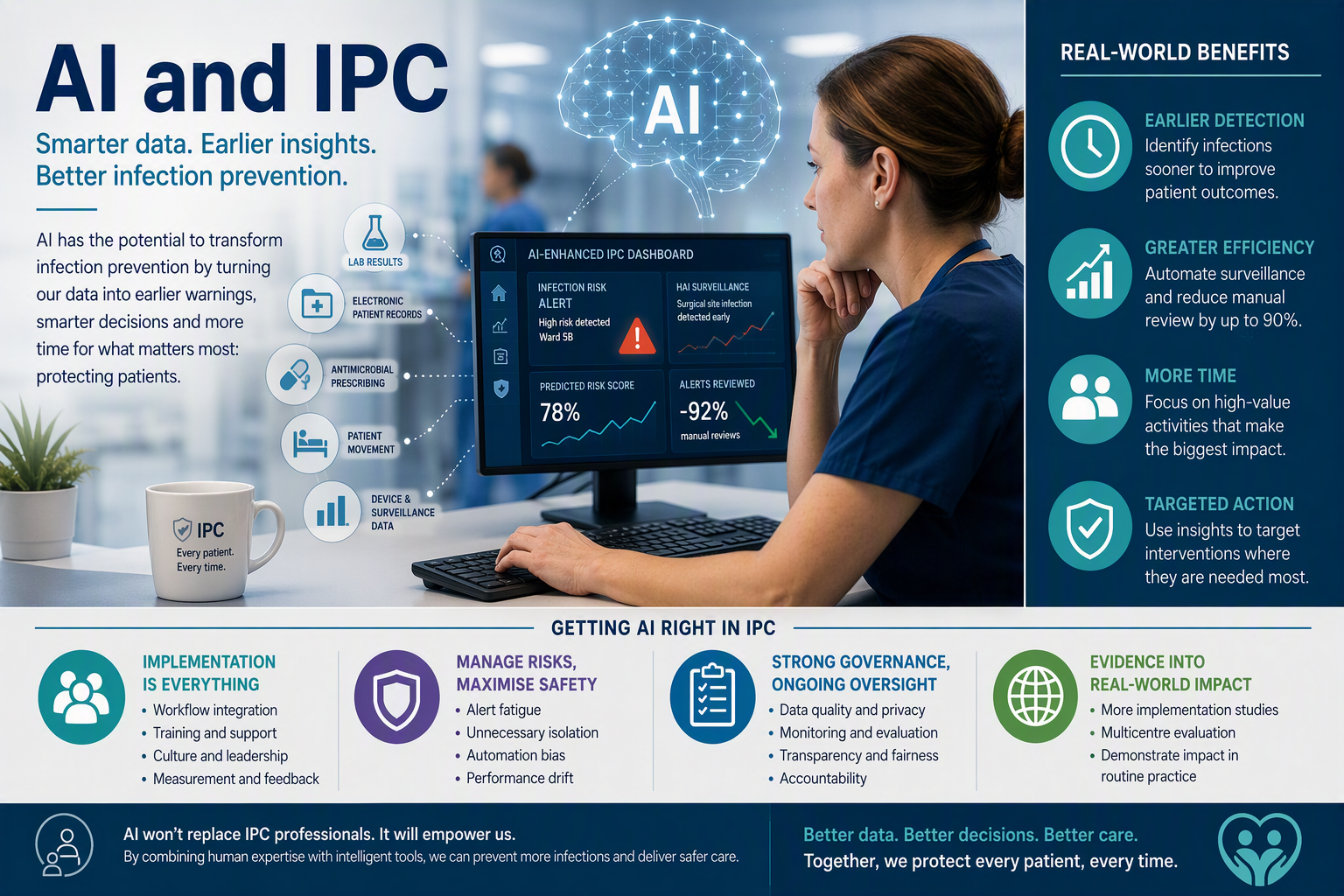
For years, many of us have talked about the potential for AI to transform healthcare. In infection prevention, we work in one of the most data-rich areas of healthcare. IPC teams draw information from laboratory results, electronic patient records, antimicrobial prescribing systems, patient movement data, device utilisation records, and surveillance systems. Yet despite having access to all this information, we often rely on manual processes to identify risks, detect problems and target interventions. This is crying out for AI-based tools!
The review demonstrates that researchers have already developed AI tools to support a wide range of IPC activities, including surgical site infection detection, healthcare-associated infection surveillance, multidrug-resistant organism prediction, antimicrobial stewardship and outbreak detection. Machine learning was by far the most common approach, accounting for more than 70% of studies.
Real-world benefits are already emerging
Some of the systems included in the review are already delivering practical benefits. Several studies reported earlier identification of infections, improved surveillance efficiency and reductions in the amount of manual review required. One system reduced manual surgical site infection reviews by more than 90%, while others identified cases that might otherwise have been missed through traditional surveillance approaches.
Every IPC professional knows that time is one of our most precious resources. Surveillance remains fundamental to infection prevention, but it can also be hugely labour-intensive. If AI can automate parts of that process, it creates opportunities for practitioners to spend more time where they add the greatest value, in supporting frontline teams, investigating outbreaks, implementing improvement initiatives and influencing patient care.
A familiar lesson for IPC
The review had a keen and healthy interest on implementation rather than just research and technology. IPC professionals have long understood that generating evidence is only half the challenge. Translating this into practice is much harder. We've seen this with hand hygiene, care bundles, antimicrobial stewardship, and countless quality improvement initiatives. Success depends on people, culture, leadership, workflow, training and measurement. Even highly effective interventions fail if they don't fit the realities of day-to-day clinical practice.
The same principle applies to AI. The review repeatedly highlights the importance of workflow integration, governance, monitoring and evaluation.
Keeping an eye on unintended consequences
Like any healthcare innovation, AI brings potential risks as well as benefits. The review highlights concerns such as alert fatigue, unnecessary isolation, automation bias, and performance drift as clinical practices and patient populations change over time.
These challenges aren't unique to AI, but they do reinforce the need for strong governance, monitoring and oversight. We can’t AI because it carries risks, but rather aim to implement it in a way that maximises benefits while managing unintended consequences. In many ways, that's exactly the approach IPC teams already take with any new intervention or technology.
Some limitations worth noting
As with any systematic review, it is important to recognise the study's limitations. The included studies were highly heterogeneous, covering different infections, healthcare settings, outcome measures and AI methodologies. This made direct comparisons difficult and prevented meaningful pooling of many results. The evidence base was also dominated by retrospective development and validation studies, with relatively few real-world implementation evaluations. Most studies originated from a small number of countries with mature digital infrastructures, particularly the United States, meaning the findings may not be fully transferable to healthcare systems with different electronic record capabilities or data environments. Many studies lacked external validation, standardised outcome reporting and robust evaluation designs. In some cases, promising predictive performance was demonstrated, but evidence of clinical impact remained limited.
These limitations don't diminish the importance of the review. If anything, they help identify the next priorities for research. The field now needs more implementation studies, more multicentre evaluations, and greater focus on demonstrating impact in routine clinical practice rather than simply improving algorithm performance.
Looking ahead
Whether you ‘like’ AI or not is irrelevant now. It’s a part of our future in infection prevention (and life in general). We're seeing increasing interest, growing maturity, and a recognition that success will depend on implementation as much as innovation. The conversation is evolving from model development to real-world adoption, governance and patient benefit. IPC teams are under constant pressure to do more with finite resources. Any technology that helps us identify risk earlier, target interventions more effectively, or release time for higher-value activities deserves serious attention.
Subscribe
Subscribe to our email list if you’d like us to let you know about future Journal Clubs, Insight Webinars, and for other updates from IPC Partners.
This website uses cookies to improve your experience. Learn more