

Are we concentrating enough on chlorine concentration?
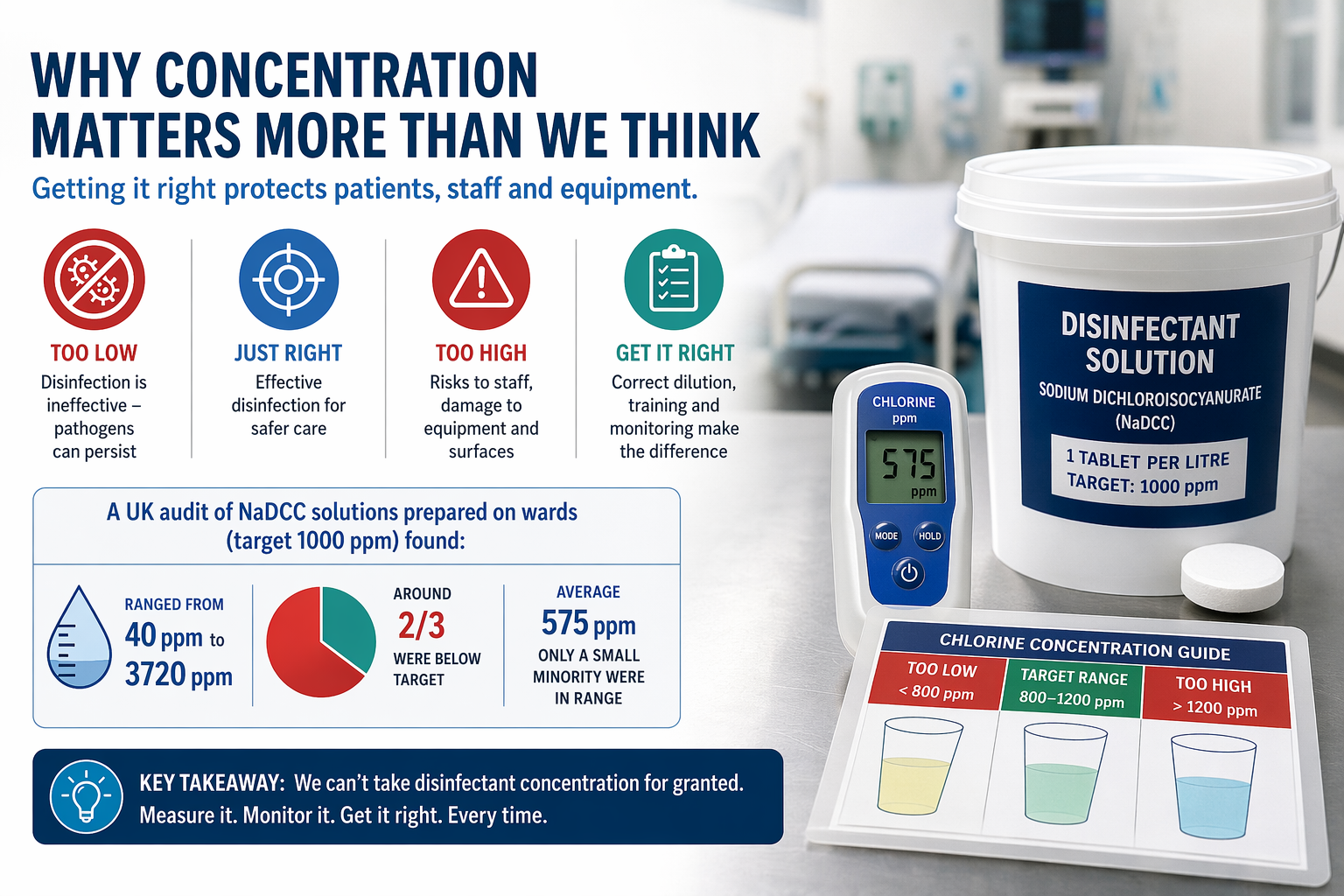
Environmental hygiene remains a cornerstone of infection prevention and control. And we spend a long time optimising processes to make sure that cleaning and disinfection is as thorough as can be. However, a recent study suggests that these efforts may, at times, be in vain because the concentration of the active chemical (in the case of this study chlorine) may not be at the concentration we think we are?
A small audit at University Hospitals Birmingham in the UK explored this using sodium dichloroisocyanurate (NaDCC) solutions prepared on wards, targeting 1000 ppm in line with national guidance. On paper, the instructions for use were as simple as could be: one tablet per litre. However, across 28 samples collected from 7 clinical areas, concentrations in-use ranged from 40 ppm to 3720 ppm. Around two-thirds were below target, with an average of 575 ppm, and only a small minority fell within the acceptable range.
It probably goes without saying that if concentrations of chlorine are too low, disinfection will be ineffective, allowing pathogens to persist. It could even be that repeated exposure to suboptimal levels could contribute to reduced susceptibility (although I think this is unlikely given we’ve been using chlorine forever, often at sub-optimal concentrations, and we don’t see meaningful reduced susceptibility). On the flip side, excessively high concentrations are not good either. They can damage equipment and pose risks to staff. So, getting it wrong in either direction affects both safety and effectiveness.
The authors helpfully added a qualitative element to the evaluation. Staff interviews pointed to practical barriers, including respiratory concerns, gaps in training, and the time required for tablets to dissolve. Variation between staff groups and clinical areas suggests a wider system issue rather than individual error. Whilst the study didn’t set out to understand why the chlorine concentration was too low, it seems likely that this was a combination of incorrect dilution, extended duration of use, and the impact of contact with organic matter finding its way into the prepared disinfectant (e.g. on a double-dipped cloth or mop).
This was a small, single-centre audit, and the findings should be interpreted with caution. The sample size was small (28 measurements from 7 clinical areas), and the work focused on a single product (NaDCC tablets) within one organisation, which may affect generalisability to other settings or formulations. The study also provides a point-in-time assessment of chlorine concentration rather than longitudinal data, so it cannot capture variability over time or the impact of interventions. In addition, while the biological plausibility is strong, the audit did not directly link chlorine concentration to environmental bioburden, safety issues for staff, material compatibility, or clinical outcomes such as infection rates. Nonetheless, the simplicity of the approach highlights a potential gap between policy and practice that is likely to be relevant beyond the study site.
So what should we do?
- We need to reinforce the importance of correct dilution, avoiding extended duration of usage, and protecting disinfecting solutions from contact with organic matter. This will require careful training and ongoing monitoring.
- Moving towards pre-prepared disinfectant solutions would help here – but will probably not be a sustainable option for all cleaning and disinfection in most settings.
- Looking beyond chlorine as an active agent for disinfection will help – we know that chlorine is more prone to inactive when it comes into contact with organic matter than other chemistries.
These findings show that we can’t take the concentration of chlorine (or any other chemical for that matter) for granted. Perhaps we should all get out there and measure the concentration of the active chemical in our disinfectant solutions?
Subscribe
Subscribe to our email list if you’d like us to let you know about future Journal Clubs, Insight Webinars, and for other updates from IPC Partners.
This website uses cookies to improve your experience. Learn more