

Are we talking the same language? We need to watch our language when communicating AMR (and everything else for that matter)
Communication as an overlooked intervention
In infection prevention and control, we are used to dealing with complexity. We talk comfortably (and I hope at least most of the time knowledgably!) about micro-organisms, transmission routes, microbial ecology, antibiotic mechanisms, and surveillance definitions. But sometimes our knowledge and understanding of these issues can backfire, and we find ourselves unable to communicate this complexity effectively and powerfully to others. This one is a bit of a long read, but I hope you find it useful!
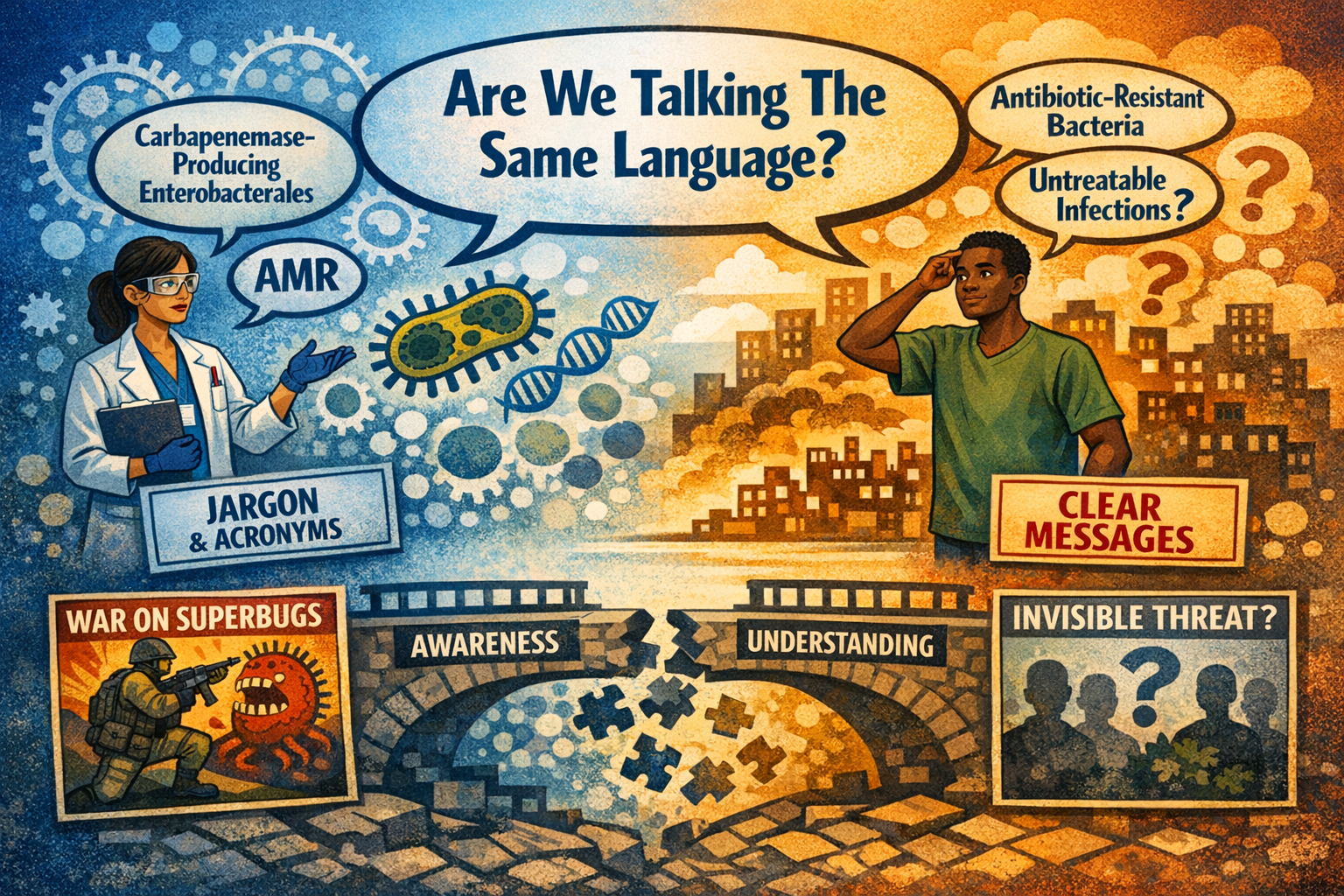
The language we use to describe infections and antimicrobial resistance (AMR) is a good example of how we can get this wrong. If our language is too full of acronyms and jargon, even the most carefully designed interventions can fall short. Some work done by Wellcome years ago is still relevant and illustrative of these issues. Through surveying the public, they found that “AMR” landed flat – and connected with basically nobody. Similarly, the idea of “resistance” created confusion, becuase most people felt that if something is “resistant”, there’s still a chance that the resistance could be overcome! The advice from this survey was to focus on infections that can’t be treated with antibiotics.
As part of the same work with the public, Wellcome explored various “ways in” to a discussion about AMR (or should I say a discussion about infections that can’t be treated with antibiotics!). They found that measures of impact that talked about “the world” or “our world” (e.g. global or system level costs) were far less effective than measures of impact that talked about “my world” (i.e. we may not be able to treat an infection that you develop).
I have my own experience of the importance of language in communicating AMR to relate. About 10 years ago, I was leading a study that required us to collected rectal swabs from >4,000 patients being admitted to hospital. Now, it turned out to be quite a challenge to convince people to consent to having a rectal swab for research purposes (who knew!). Since we were struggling with recruitment, I went out with the swabbing teams to observe their interaction with patients. It was clear that our message to the patients was far too technical (“We’re doing a study about carbapenemase-producing Enterobacterales...”) and did not connect with “their world”. When we change the message to be much more straightforward (“We are doing a study about antibiotic-resistant bacteria”) that connected with “their world” (“knowing whehter or not you are colonised will help us to treat you if you develop an infection and will help to protect other patients”), compliance increased and we were able to complete the study.
How we currently talk about AMR
Against this backdrop, a recent paper in the Journal of Risk Research offers an important contribution by examining how we talk about AMR globally, focusing on the metaphors that seem to dominate public discourse. The authors analysed a wide range of sources, including international organisational websites, national AMR action plans, newspaper articles, and social media posts. Across these materials, they identified more than two thousand metaphorical expressions grouped into forty-one themes.
Despite this apparent diversity, most of the language converges on a small number of familiar themes. Three-quarters of all metaphors fell into four dominant categories:
- war,
- heroes and villains,
- apocalyptic futures,
- AMR as a silent, creeping threat.
These are the phrases we encounter daily e.g. fighting infection, battling superbugs, facing a post-antibiotic apocalypse, or sleepwalking into an invisible crisis. At first glance, this language seems compelling. It is vivid and emotionally engaging and shouts urgency. But does it actually improve understanding? And what could be the unintended consequences?
Awareness without understanding
The central finding of the study is that these dominant metaphors are effective at raising awareness, but they rarely help people understand the underlying science or what actions are required. They tend to amplify concern without explaining how resistance develops, why antibiotics fail, or how behaviour influences outcomes. In practice, this means that people may recognise AMR as a serious issue but continue to hold fundamental misconceptions, for example, believing that their body (rather than bacteria) becomes resistant to antibiotics. For a problem as complex and behaviour-dependent as AMR, this gap between awareness and understanding is important.
When metaphors mislead
Whilst metaphors are not intended to give a complete picture of any issue in any context, there is some evidence that the metaphors often used to describe AMR may mislead. For example, describing AMR as a war implies a finite battle with a clear enemy and the possibility of victory. In reality, AMR is a continuous evolutionary process shaped by microbial ecology. The language of warfare may therefore reinforce an inaccurate mental model, encouraging the expectation that the problem can be “won” rather than managed.
Equally, describing “superbugs” as villains and antibiotics as heroes introduces similar distortions. It simplifies a complex biological system into a binary struggle between good and evil, obscuring the fact that many microbes are beneficial and that antibiotics themselves can cause harm when misused.
Apocalyptic metaphors create a different kind of problem. Whilst they attract attention, they risk developing a sense of fatalism. If AMR is presented as an inevitable collapse into a post-antibiotic world, individuals may feel powerless to influence the outcome. Evidence cited by the study suggests that overly alarmist messaging can discourage engagement and behaviour change.
Even subtler metaphor choices, such as describing AMR as a “silent” threat, may have unintended consequences. Although this reflects the gradual nature of resistance, it can reduce perceived urgency when people interpret “silent” as meaning distant or less immediate.
Limitations
A key limitation of this study lies in its reliance on qualitative content analysis of English-language public discourse, which, whilst broad in scope, remains inherently interpretive and potentially subjective despite the use of structured coding frameworks. The analysis was also restricted to written, text-based sources, excluding audio-visual materials such as television, radio, and video campaigns, which are increasingly important channels for AMR communication and may use metaphor in different ways. The focus on English-language content further limits generalisability, particularly given that AMR communication must operate across diverse linguistic and cultural contexts where metaphors may function differently or carry distinct meanings. In addition, while the study carefully identifies and categorises metaphors, it does not directly measure their impact on audience understanding, attitudes, or behaviour, relying instead on theoretical appraisal and existing literature. As such, the findings are valuable for describing current discourse but should be interpreted cautiously when drawing conclusions about the real-world effectiveness of metaphor use.
Rethinking how we communicate risk
The study argues for a big rethink of how we communicate about AMR. Metaphors are not inherently problematic, and can be powerful tools for explaining complex ideas. But the problem here is that they are often ill conceived and create unintended consequences.
So, what should we do to describe AMR risks more effectively, in a way that both raises awareness and educates the audience? Improving AMR communication requires more deliberate and theory-informed approach to metaphor choice. Rather than relying on familiar but often problematic framings, communicators should aim to use single, carefully selected metaphors that are both accessible and conceptually meaningful. In particular, there is a need to develop novel metaphors grounded in familiar domains but capable of conveying the underlying biology and behaviour that drive resistance, such as highlighting that resistance develops within bacteria, or that antibiotics are ineffective against viral infections. Crucially, these metaphors should offer clear and coherent “mappings” between the metaphor and the reality of AMR, helping to build accurate mental models rather than simply evoking emotion. This also means moving away from well-worn but misleading narratives (such as warfare, heroes and villains, or apocalyptic collapse), which may capture attention but fail to support understanding or behaviour change. Instead, the focus should be on metaphors that are both apt and explanatory, supporting more effective and actionable communication about AMR. The article doesn’t go so far as to make suggestions of new types of AMR-related metaphors but here’s one to discuss:
“Bacteria are as different from viruses as goldfish are from giraffes”!
Effective AMR communication also requires recognising that different audiences require different approaches. Patients, clinicians, policymakers, and the public do not interpret language in the same way, and so we need to be aware of these differences when deciding on the best way to get our message across.
A familiar problem in IPC
Communicating the issues around AMR are just one example of how important our choice of language is in communicating around IPC, HCAI, and AMR. Differences in terminology can lead to misunderstanding even among professionals, for example, surveillance definitions such as SSI vary widely between clinicians, scientists and the public, creating confusion and inconsistency in practice. Language also shapes patient experience, as seen in reports of patients with CPE feeling stigmatised and labelled with our choice of terms - sometimes being made to feel like they have “plague” or a like a “pariah”, underscoring the need for more thoughtful, patient-centred communication. At a system level, the clarity of guidelines and reports directly influences healthcare worker behaviour, with ambiguous or overly complex wording acting as a barrier to adherence. Taken together, these examples reinforce that whether communicating with expert clinicians, general healthcare staff, patients or the public, precise, consistent and audience-appropriate language is essential to support understanding, trust, and effective implementation of IPC measures.
Are we talking the same language?
The evidence suggests that too often, we are not. The words we use may feel clear and compelling within the infection community, but they do not always translate into shared understanding beyond it. Instead, they can reinforce misconceptions, create unhelpful narratives, or simply fail to resonate. If we want to change behaviour (and ultimately outcomes), we need to choose our words carefully!
Subscribe
Subscribe to our email list if you’d like us to let you know about future Journal Clubs, Insight Webinars, and for other updates from IPC Partners.
This website uses cookies to improve your experience. Learn more