

Assessing the stability and sporicidal efficacy of oxidizing disinfectants
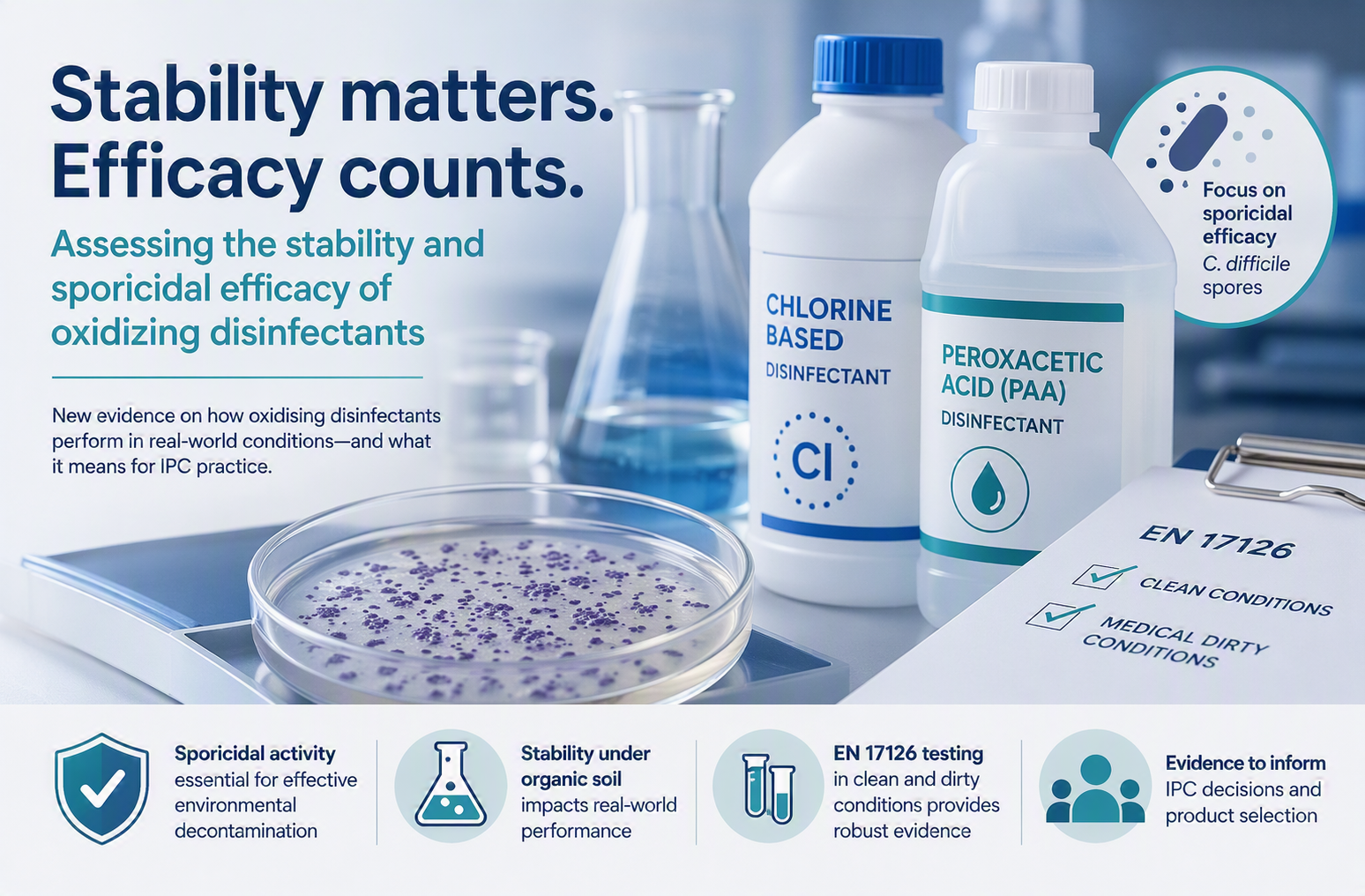
I’m really looking forward to this week’s IPC Partners Journal Club in partnership with GAMA Healthcare which you can register for here. The Journal Club is based on a paper which I co-authored with Jon and some others a few years ago, published in Journal of Hospital Infection.
Assessing the efficacy of the disinfectant agents we use in healthcare is complex, with numerous factors to consider such as contact times, spectrum of activity, the presence of organic matter, material compatibility and more! Added to this, a lot of efficacy for some chemistries that we have been using for years is assumed, and doesn’t necessarily stand up to scrutiny. In this paper the research team set out to examine the stability and sporicidal activity of various oxidizing agents, including peracetic acid.
What do we mean by sporicidal, and how do we assess it?
A good place to start is understanding exactly what we mean by sporicidal. Sporicidal activity refers to the inactivation of bacterial endospores. Endospores produced by organisms such as Clostridioides difficile can survive for many months on surfaces, resist desiccation, tolerate many disinfectants, and persist despite routine cleaning. Therefore, sporicidal efficacy is essential for disinfectants used in healthcare, particularly in outbreak settings and for the decontamination of isolation rooms following patient discharge.
One of the standardised tests to assess sporicidal activity is using EN 17126:2018, a quantitative suspension test designed specifically for medical settings. The standard requires a disinfectant to achieve a 99.99% (≥4‑log10) reduction in viable spores within a defined contact time. Importantly, EN 17126 includes both clean and medical dirty soil conditions to reflect real‑world challenges. This ensures that products are evaluated not only for their intrinsic antimicrobial activity, but also for their ability to remain effective in the presence of organic matter.
This study is one of the first to evaluate both sporicidal activity and chemical stability under the same soil conditions, providing a clearer understanding of why some disinfectants fail in dirty conditions.
What the study examined
The researchers evaluated the performance of several oxidising disinfectants commonly used in healthcare under:
- Clean conditions: 0.3 g/L bovine serum albumin (BSA)
- Medical dirty conditions: 3 g/L BSA + 3 mL/L erythrocytes
They assessed:
- Chemical stability – how much active disinfectant remained after exposure to soil over 5 minutes
- Sporicidal efficacy – log10 reduction in C. difficile ribotype 027 spores after 5 minutes
Key findings
Chlorine-based disinfectants showed poor stability and reduced sporicidal activity in dirty conditions.
NaDCC at 1,000 ppm (the concentration widely used in UK healthcare and recommended by the National Infection Prevention and Control Manual) degraded rapidly when exposed to organic matter. After 5 minutes in medical dirty conditions, NaDCC (1,000 ppm) retained only 3–4% of its active chlorine and showed almost no measurable sporicidal effect.
At 10,000 ppm, NaDCC remained stable and achieved the required ≥4‑log10 reduction. However, this concentration is unsuitable for routine disinfection due to corrosivity, odour, material compatibility, and staff exposure concerns.
Interestingly, significant differences were observed between the PAA liquid and the preformulated PAA product. The preformulated PAA product achieved the required log reduction in both test conditions, whereas the PAA liquid failed in both. This suggests that product formulation plays a critical role in ensuring sporicidal efficacy.
Importantly, the study’s comparative approach, testing several disinfectants side‑by‑side under the same EN 17126 conditions which offers robust evidence to inform real world product selection in healthcare.
Limitations
- Suspension testing only: The study used test tube suspensions rather than dried surface contamination. Surface based studies may provide additional insight into real world performance.
- Single organism: Only one ribotype of C. difficile spores were tested. Other spore‑forming or emerging pathogens (e.g., Candida auris) may behave differently.
- Use concentrations: Products were tested at their recommended use concentrations, which vary between chemistries. Some differences may therefore be concentration dependent.
What this means for IPC
The study demonstrates that chlorine-based disinfectants at commonly used concentrations may be chemically inactivated by organic matter before they can exert sporicidal activity. This has clear implications for environmental decontamination in healthcare.
IPC teams should ensure that products claiming sporicidal activity have been tested under EN 17126 dirty conditions, not just clean conditions.
Based on the findings of this study, given their stability and efficacy, PAA based products in some formulations offer a potential alternative to chlorine-based products.
Conclusion
This study provides important evidence that sporicidal activity and chemical stability must be considered together when selecting disinfectants for use in healthcare. Chlorine-based products at standard concentrations may be significantly compromised in the presence of organic matter. Product testing under realistic soil conditions is essential, and environmental decontamination strategies must reflect the chemical realities of disinfectant performance.
Subscribe
Subscribe to our email list if you’d like us to let you know about future Journal Clubs, Insight Webinars, and for other updates from IPC Partners.
This website uses cookies to improve your experience. Learn more