

Candidozyma auris and the challenge of biofilms: a primer
Candidozyma auris (previously classified as Candida auris), has rapidly emerged as one of the most formidable fungal pathogens in modern healthcare. Recognized by the World Health Organization as a critical priority pathogen, C. auris poses unique infection prevention challenges due to its multidrug resistance, environmental persistence, and its ability to form biofilms on skin, medical devices, and healthcare surfaces.
We know that biofilms are a vital part of microbial life – and micros exist in multispecies biofilm more than in any other state. We also know that things are very different when microbial cells attach to surfaces and begin to form biofilms. For example, bacteria in biofilms are known to be many times less susceptible to antibacterial agents than bacteria in suspension. Biofilm formation is now understood as a central factor in the organism’s epidemiology, outbreak potential, and resistance profile. In this blog, I explore the biology, clinical implications, and emerging research on C. auris biofilms.
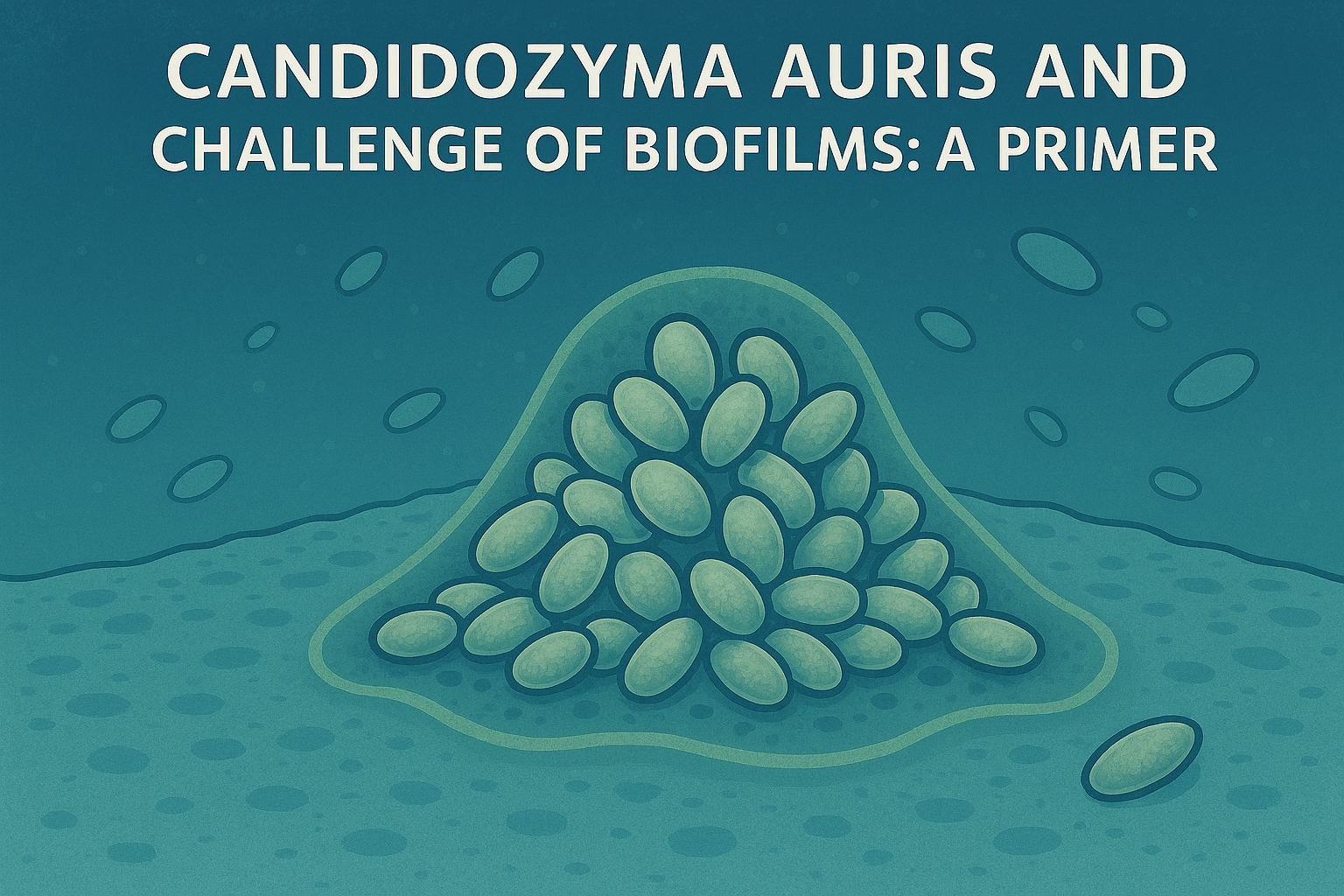
Biofilm formation: extended survival, reduced susceptibility
One of the most important contributors to C. auris pathogenicity is its ability to form highly tolerant biofilms. These multicellular communities adhere strongly to surfaces and are embedded in protective extracellular matrices.
Biofilms allow C. auris to:
- Contaminate and persist on environmental surfaces in healthcare environments
- Colonise skin, creating reservoirs for onward transmission
- Resist antifungal and disinfectant exposure
A published review in Current Clinical Microbiology Reports highlights experimental work demonstrating that C. auris biofilms enable the organism to persist on hospital surfaces for extended periods, even under desiccating conditions. The study reports that biofilms formed under conditions mimicking skin or hospital surfaces show enhanced capacity for long-term environmental survival, far exceeding that of planktonic cells. This review article also provides an overview of laboratory investigations showing that C. auris biofilms exhibit markedly reduced susceptibility to antifungal agents and disinfectants. The underlying mechanisms for this reduced susceptibility are the protective extracellular matrix and altered metabolic state within the biofilm structure.
A recent study investigated how dry surface biofilm growth influences the ability of C. auris to survive disinfectant exposure. The researchers developed 12‑day dry‑surface biofilms (DSBs) and compared their sodium hypochlorite susceptibility to planktonic cells. They found:
- Planktonic C. auris cells were readily killed by sodium hypochlorite.
- Biofilm‑associated cells, however, showed substantial tolerance, with only 2–4 log (10) reductions even at the highest tested concentrations (500–1,000 ppm) used for clinically relevant exposure times.
- Microscopy and transcriptomics revealed that DSBs upregulate ABC transporters and iron‑acquisition pathways, mechanisms thought to underlie enhanced tolerance and environmental survival.
Overall, the study reinforced that DSB enables C. auris to withstand sodium hypochlorite disinfection, helping explain the organism’s persistent survival in healthcare environments. Combine this with the near universal presence of DSB on hospital surfaces, and you can begin to understand the environmental challenge that we face with this organism!
Implications for infection prevention and control
The biofilm-producing capability of C. auris seems to contribute to IPC failures.
- Patients are colonised at multiple body sites and for extended periods. This means that shedding into the environment happens frequently and often at high quantity, resulting in increased transmission risk.
- Patient colonisation can often go undetected, perhaps due to C. auris embedded in biofilm that is present but not aways detected through swabbing.
- The same logic applied to environmental sampling – the presence of biofilm could result in a “false negative” culture in that the C. auris is present and viable but not detected by the swabbing method due to being protected in the biofilm.
- Surface biofilm, including DSB, mean that C. auris survives for extend periods on surfaces – this means that cleaning and disinfection standards, which are difficult to get right at the best of times, are even more important than ever. This is particularly important for shared medical equipment, which we know has been implicated repeatedly in C. auris outbreaks.
- Since C. auris in biofilm have reduced susceptibility to disinfectants, disinfectant choice is more complex than usual. Related to this, how we undertake and interpret disinfectant testing needs to be revised in light of biofilm producing microbes: it’s no good inferring efficacy for a disinfectant that will be used on a surface from a quantitative suspension test!
Conclusion
Biofilm formation seems to be an important part of the success of C. auris as a hospital pathogen, influencing its epidemiology, environmental resilience, and clinical impact. The biofilm-producing potential of C. auris promoted extended survival on surfaces and skin, reduces susceptibility to disinfectants and antifungal agents, and plays a key role in the transmission dynamics of C. auris. As C. auris continues to emerge globally, effective control strategies will depend on improved understanding of its biofilm biology and the development of interventions specifically designed to address established biofilm or prevent biofilm formation.
Subscribe
Subscribe to our email list if you’d like us to let you know about future Journal Clubs and for other updates from IPC Partners.
This website uses cookies to improve your experience. Learn more