

Getting the fundamentals right
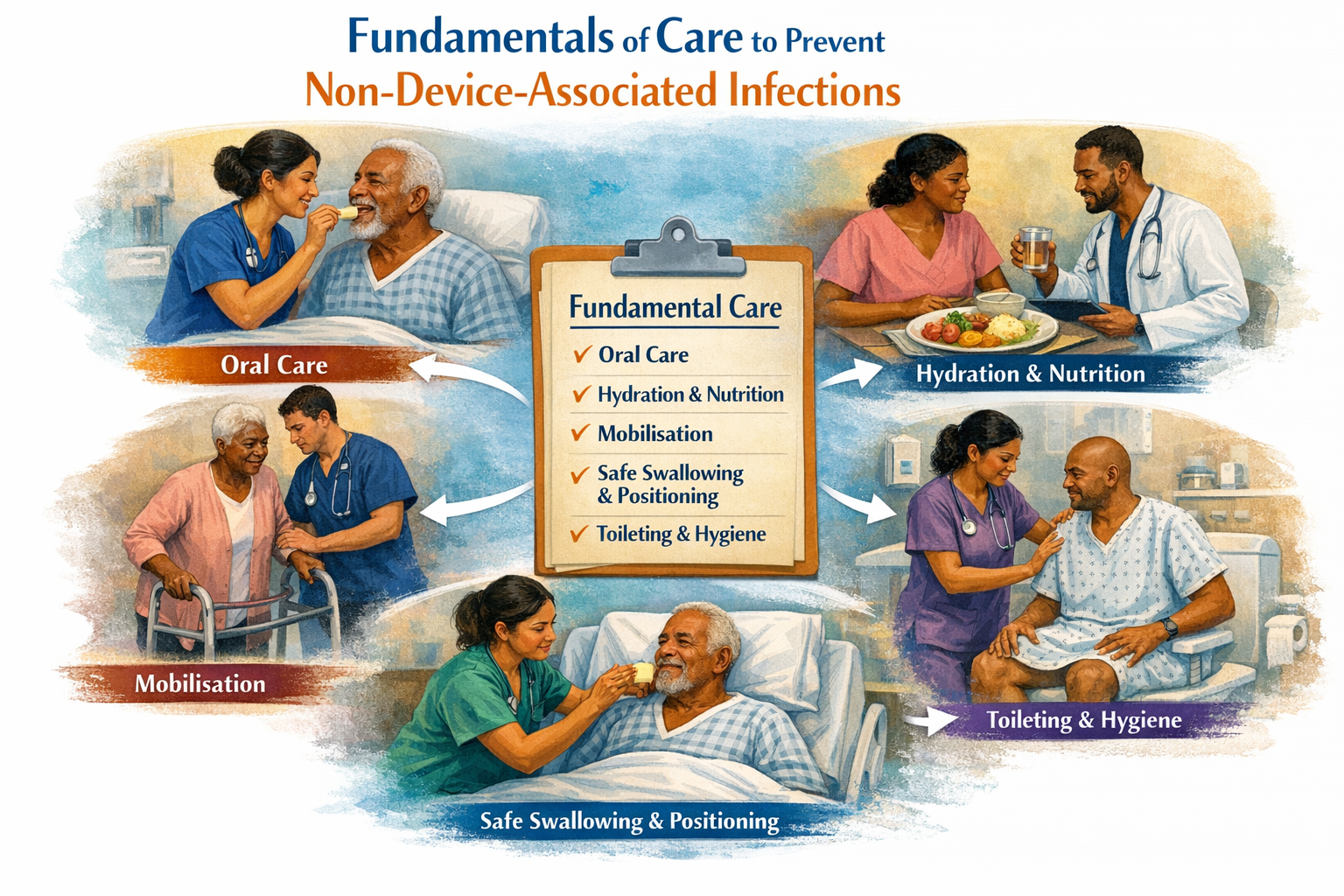
We have spent decades refining highly technical, device-focused strategies: bundles, checklists etc. And yet a substantial proportion of HCAI occur without any device at all. These “non–device-associated" HCAI infections (NDA-HAIs) include pneumonia, urinary tract infection, gastrointestinal infection, surgical site infection, and wound infection, and collectively account for a large share of the burden we are trying to reduce. Many of the things that influence these infections are good basic practice, often described as the ‘fundamentals of care’.
A recent scoping review in the American Journal of Infection Control usefully highlights the importance of this topic. The authors examine the role of fundamental nursing care interventions in preventing NDA-HCAIs, and in doing so, remind us that infection prevention is about the consistency and quality of basic care. Whilst device-associated infections are vitally important, they can become a distraction from establishing and delivering the fundamentals of care.
The hidden burden of non-device infections
The review highlights that a significant proportion of pneumonia occurs in non-intubated patients, and a substantial number of UTIs are not catheter-associated. These are infections that cannot be prevented by simply removing or optimising devices. Instead, they are shaped by patient vulnerability, environment, and how care is delivered at the bedside. If the biggest proportion of HCAIs are non-device-associated, then focusing exclusively on technical interventions around devices will never be enough.
I read a study years ago that has influenced my thinking on HCAI. The review ranked common HCAIs by prevalence, and by their impact in terms of cost. The most costly HCAI, from a healthcare economic impact viewpoint, was pneumonia. And yet the focus of our infection prevention activities are rarely preventing pneumonia!
What do we mean by “fundamentals of care”?
The concept of fundamental nursing care is increasingly relevant. At its core, it encompasses the essential physical, psychosocial, and relational aspects of care that every patient requires: hygiene, nutrition, hydration, mobility, comfort, dignity, and engagement. This review nicely applies these fundamentals as infection prevention interventions. This makes complete sense, because oral care, hydration, mobilisation, positioning, toileting, and nutrition are all directly linked to infection risk.
What does the evidence tell us?
The review identified 157 studies examining the relationship between fundamental care and NDA-HCAIs. Some interventions have a stronger evidence base than others. Oral care stands out, particularly in relation to hospital-acquired pneumonia, with high-quality studies including randomised trials and systematic reviews. Interventions such as dysphagia assessment, safe swallowing, and positioning also feature prominently, again mainly linked to pneumonia prevention. Meanwhile, other areas such as nutrition, gastrointestinal infections, wound care, are comparatively underexplored. Not necessarily unimportant, just underexplored. There is an opportunity for future studies to explore the impact of a bundle of fundamental care interventions.
Limitations
Limitations include that the evidence base for fundamental nursing care interventions in preventing NDA-HCAIs remains fragmented and often low quality, with most studies rated at lower levels of evidence and relatively few high-quality randomised trials outside of specific areas such as oral care. The literature is skewed towards pneumonia, leaving significant gaps in understanding for other common infections such as gastrointestinal infections and wound infections, and many studies focus on single interventions rather than the combined, real-world delivery of care. As a scoping review, the study maps available evidence rather than evaluating effectiveness, meaning that causal relationships and effect sizes remain uncertain. In addition, the focus on interventions explicitly labelled as “nursing care” may have excluded relevant interdisciplinary evidence, and the restriction to English-language studies and a limited number of databases introduces the potential for selection bias. Taken together, these limitations do not undermine the importance of fundamental care, but they do highlight the need for more rigorous, integrated research that reflects the complexity of bedside practice and evaluates how combinations of fundamental
Consistency is key
Perhaps the most important finding from teh study is about how care is actually delivered at the bedside. Poor quality, missed, or inconsistent nursing care is associated with worse outcomes, including higher infection rates, and yet some of the most impactful interventions (oral hygiene, mobilisation, hydration, safe swallowing) are most prone to being deprioritised under pressure. In busy clinical environments, fundamental care is at risk of failure because systems are not reliably designed to support its delivery: staffing constraints, competing demands, fragmented workflows, and organisational culture all influence whether these basics happen consistently. Getting the fundamentals right requires safe systems of work – individual heroics won’t solve this!
Subscribe
Subscribe to our email list if you’d like us to let you know about future Journal Clubs, Insight Webinars, and for other updates from IPC Partners.
This website uses cookies to improve your experience. Learn more