

Hospital sinks and drains: what can be done to reduce transmission risk?
For most people working on the wards in healthcare, sinks barely register as a topic of conversation. They are simply part of the background. We wash our hands (sometimes!), dispose of small amounts of liquid waste (often not ok), and move on with the business of caring for patients. Yet over the past decade, the humble hospital sink has become one of the most scrutinised pieces of infrastructure in infection prevention!
A recent review by Bobby Warren and Deverick Anderson brings together the growing body of evidence linking sinks and wastewater drainage systems with healthcare-associated infections. Their article provides a timely reminder that sinks and water drainage systems present a clear and present danger for transmission in our hospitals.
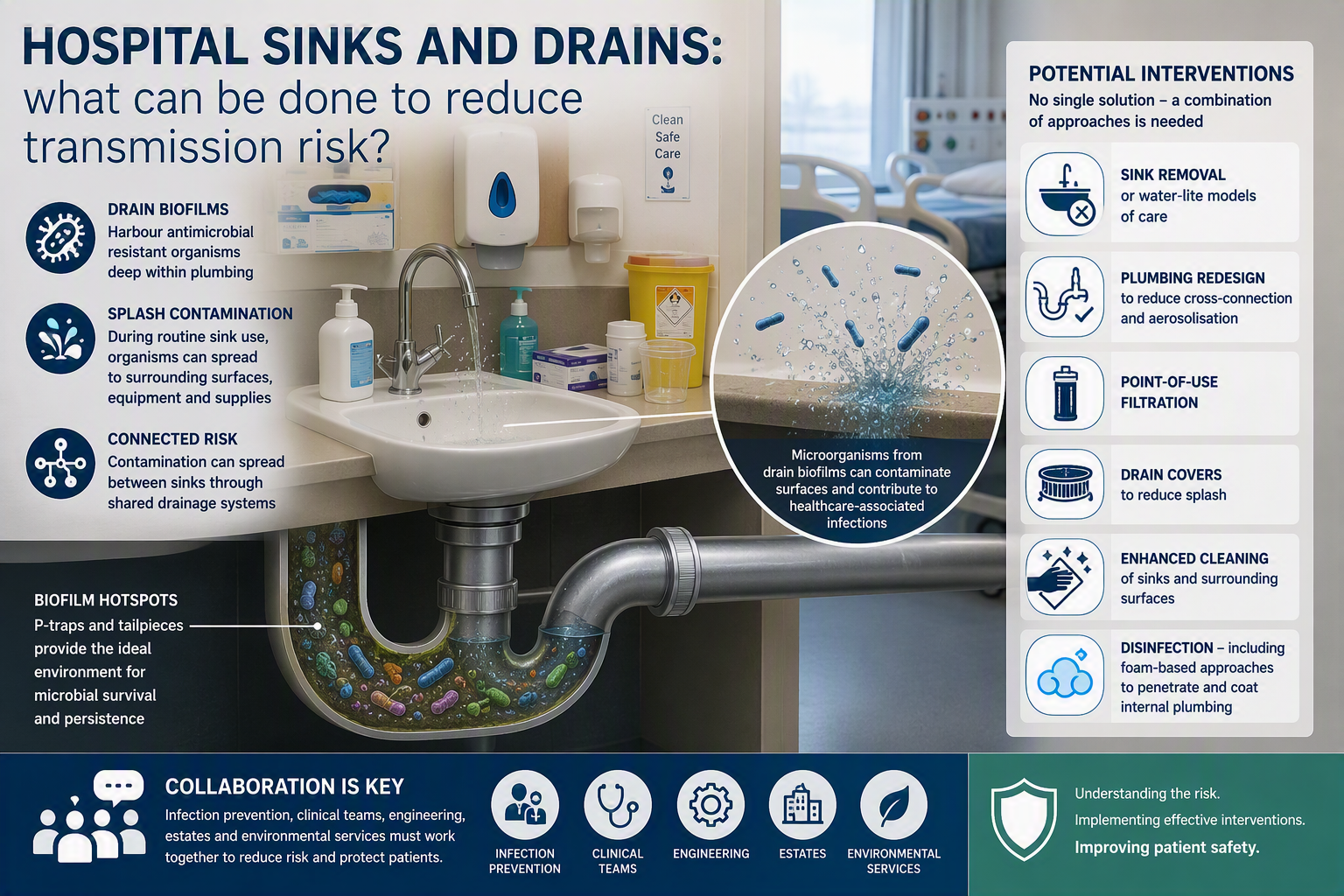
Biofilms are an integral part of this story. Deep within sink plumbing, particularly in tailpipes and P-traps (aka U bends), conditions are ideal for microbial survival. Moisture is constant. Nutrients are regularly introduced. Microorganisms arrive daily through routine clinical activity – and this is what we want – for microorganisms to be washed from hands and be disposed of down the sink drain! Over time, these environments become home to complex microbial communities that can include organisms, some of whom are antimicrobial resistant, that we would rather not find anywhere near our patients, including Pseudomonas aeruginosa, Acinetobacter species, Stenotrophomonas maltophilia, non-tuberculous mycobacteria and various Enterobacterales including CPE.
The evidence suggests that organisms can spread from drain biofilms onto surrounding surfaces through splash contamination during routine sink use. Equipment and supplies placed near sinks may become contaminated, creating opportunities for onward transmission. In interconnected plumbing systems, contamination may even spread between sinks through shared drainage networks.
For infection prevention teams, none of this is entirely new. Many of us have investigated outbreaks where environmental reservoirs played a role, often involving multidrug-resistant Gram-negative organisms. But as the evidence emerges, it seems that transmission events linked to contaminated sinks and drains are more frequent than we might have expected at the start of this journey. Interestingly, the review highlights unpublished CDC investigations suggesting that more than one in five healthcare outbreak consultations involved water sources.
What can be done?
Unfortunately, the answer is less straightforward than we would like. There is no single intervention that reliably eliminates the risk. The review describes a range of approaches, including sink removal, plumbing redesign, point-of-use filtration, drain covers, enhanced cleaning and various disinfection methods. The challenge is that the evidence base remains surprisingly limited. A systematic review identified only 11 eligible studies assessing sink interventions, with no randomised controlled trials and considerable heterogeneity between studies.
One area that caught my attention was the discussion of drain disinfection. At first glance, pouring disinfectant down a drain sounds like an obvious solution. However, the physics of plumbing make things more complicated. Large volumes may be required simply to displace the water already present in the P-trap, and disinfectants can become rapidly diluted before reaching all the surfaces where biofilms reside. Some parts of the plumbing system may never receive adequate exposure at all.
This has led researchers to explore alternative approaches, including foam-based disinfectants. Unlike liquids, foam can coat surfaces above the water line and maintain contact with the internal plumbing structure for longer periods. The review summarises studies suggesting that routine application of disinfectant foam can reduce contamination and slow the emergence of clinically important pathogens in sink plumbing. The results are encouraging, although they are still focused largely on environmental outcomes rather than patient infections.
Observational studies reveal that sinks are frequently surrounded by equipment, patient-care items, hygiene products and other materials. In one study, only 8% of sinks were completely free of items during observations. The way we use sinks, and the behaviours that surround them, are just as important as the engineering beneath them.
The review reinforces an even more fundamental question: should patient-room sinks exist at all? Some centres have explored "water-lite" models of care, replacing traditional sink-based activities with alternatives such as alcohol-based hand hygiene and disposable patient-care systems. While intriguing, such approaches come with practical challenges and require careful evaluation before widespread adoption.
The pathogens we seek to control do not respect the neat boundaries we create between patient care, engineering, estates management and environmental services. Effective solutions will almost certainly require collaboration across all of these areas. The hospital sink may never be the most glamorous topic in infection prevention – but it’s crucial for us to fully understand the risk and rapidly develop effective interventions. Finally, I’m looking forward to hearing what Dr Issy Centeleghe has to say about this topic in her Insight Webinar next week!
Subscribe
Subscribe to our email list if you’d like us to let you know about future Journal Clubs, Insight Webinars, and for other updates from IPC Partners.
This website uses cookies to improve your experience. Learn more