

Hypochlorous acid: the future of hand hygiene?
Hand hygiene is one of the most fundamental practices in infection prevention. Yet, despite decades of innovation, we still rely largely on the same two approaches that have dominated healthcare for years: alcohol-based handrubs or soap and water.
That may be about to change. A growing body of evidence suggests that hypochlorous acid (HOCl), a chlorine-based biocide, could represent one of the most significant developments in hand hygiene since alcohol handrub became the global standard. HOCl is already used extensively for wound care and other applications in healthcare, so it’s a small step to use it for hand hygiene. This blog reviews two new publications: a UKHSA rapid systematic review on alternative agents for hand hygiene to address C. difficile, and a multicentre evaluation of a HOCl-based hand hygiene product in several NHS hospital groups.
Why HOCl?
Alcohol-based hand rubs (ABHR) transformed hand hygiene. Easy to use, quick to apply, and highly effective against most healthcare-associated pathogens, they became a cornerstone of modern infection prevention. But for patients with gastrointestinal infections such as norovirus or C. difficile, guidance still recommends soap and water because alcohol has limited activity against spores and some non-enveloped viruses. As a result, healthcare workers are required to switch between products depending on the clinical situation, creating complexity and potentially reducing compliance.
For many years, infection prevention specialists have searched for a product that could combine the convenience of alcohol handrub with activity against harder-to-kill organisms. Several alternatives have been evaluated, but none have achieved widespread adoption. I’ve had my eye on HOCl for years as a potential candidate to fill this biocide gap. Historically, there have been issues with stability that preclude bottling HOCl and storing it for long periods. But a new generation of HOCl products are entering the market, which seem to have solved this stability issue.
HOCl itself is far from new or novel. It is produced naturally by human neutrophils as part of the body's immune response. It has broad antimicrobial activity and, importantly, has demonstrated activity against both C. difficile spores and norovirus.
What did the UKHSA review find?
The UKHSA recently undertook a rapid systematic review to examine whether alternatives to soap and water could reduce transmission of C. difficile in healthcare settings (see the image below). The review screened more than 3,000 studies but identified only three that met the inclusion criteria – and none of these were in an applied healthcare setting. This neatly illustrates the limited evidence base currently available.
Visual summary of UKHSA rapid systematic review of alternatives to soap and water for hand hygiene to tackle C. difficile
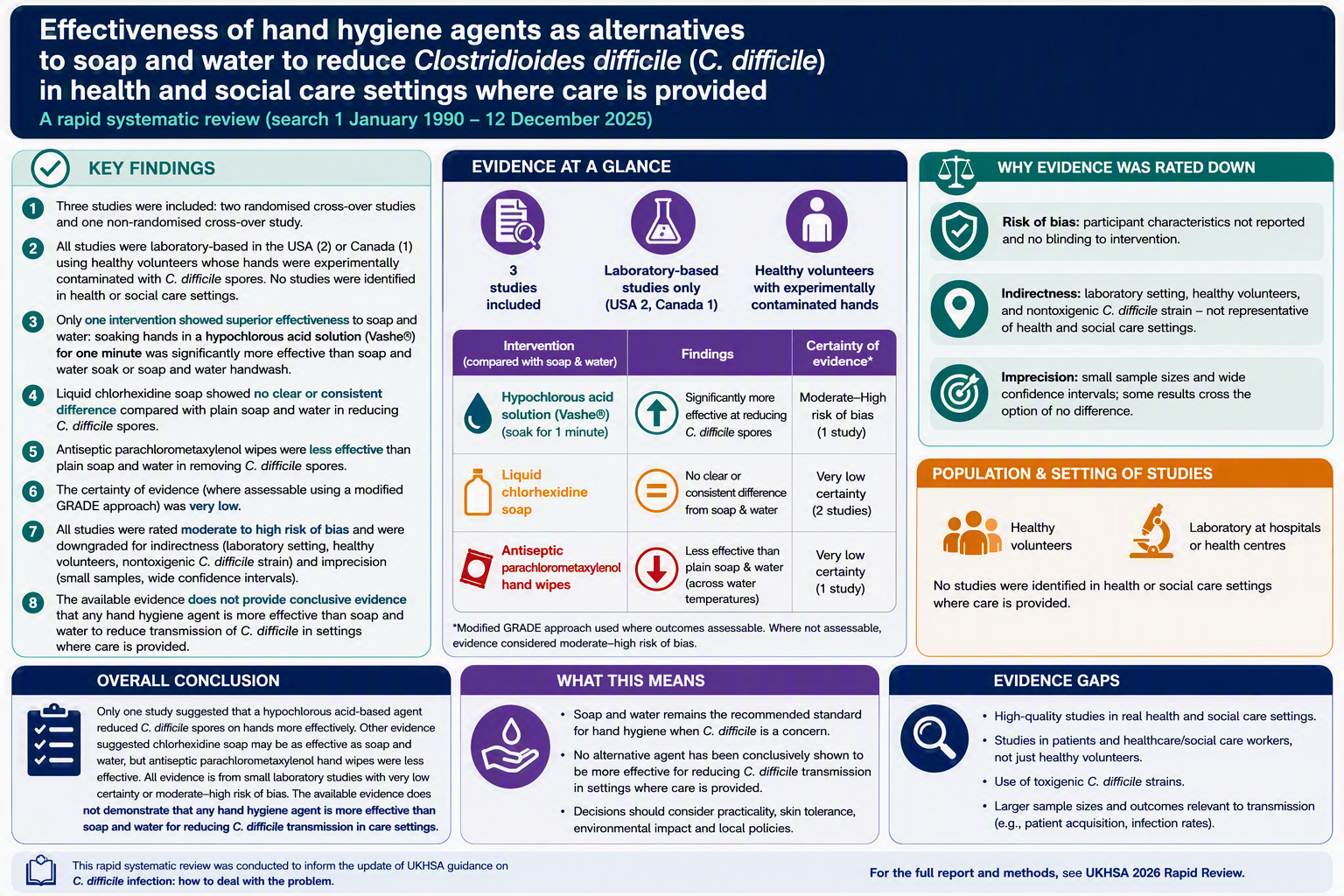
Of the three eligible studies, only one evaluated an HOCl product. In that study, a HOCl solution significantly outperformed soap and water in removing experimentally applied C. difficile spores from volunteers' hands. The intervention achieved an additional reduction of approximately 0.5 to 1.2 log10 spores compared with soap-and-water approaches. The other two eligible studies were evaluating chlorhexidine-based products, and neither were superior to soap and water.
The review therefore concluded that the HOCl intervention was the only alternative product identified that demonstrated greater effectiveness than soap and water for removal of C. difficile spores under the conditions tested.
However, the authors were appropriately cautious. The evidence came from a small laboratory-based study involving healthy volunteers rather than clinical patients, and the overall certainty of evidence remained low because of methodological limitations and small sample sizes.
Moving from the laboratory to the real world
I recently published a multicentre feasibility evaluation with colleagues from five other hospital groups of the implementing an HOCl-based hand hygiene product. We evaluated implementation in acute hospital groups and mental health facilities, with sites including Cornwall, Northampton, Bristol, Swindon, and London. The evaluation explored a set of outcomes including healthcare-associated infection rates, occupational health referrals, and staff perceptions of the product following implementation.
Across the participating acute hospital groups, there was no significant increase in healthcare-associated C. difficile infection or MSSA BSI following implementation of the HOCl hand disinfectant. No increase in outbreaks was observed either. This is an important finding – the hospital group that I currently work at has history of implementing a non-alchohol based hand “sanitiser” that turned out to be effectively bottled water. The impact of implementing this was as immediate increase in outbreaks!
Occupational health findings were encouraging. Two participating organisations reported reductions in hand-health related referrals following implementation, while the remaining sites reported no increase.
Where staff surveys were conducted, participants expressed an overall preference for the HOCl product compared with alcohol handrub. Users appreciated the way the liquid spread across the hands, although some commented on a mild chlorine smell and occasional dripping associated with its more fluid consistency.
Whilst the feasibility evaluation lacked scientific controls and was observational and pragmatic in design, the findings suggest that implementating an HOCl based hand sanitiser is both feasible and acceptable to staff.
So, is HOCl the future of hand hygiene?
I think it’s a bit too early to declare HOCl as the successor to alcohol handrub. The UKHSA review reminds us that the current evidence base remains limited and that definitive conclusions cannot yet be drawn. But for the first time in many years, we have a plausible candidate that combines broad antimicrobial activity, sporicidal potential, real-world acceptability and compatibility with routine healthcare workflows.
Finally, I’ll be leading a Journal Club next Wednesday focused on the UKHSA review. Hope you can join us (register here).
Subscribe
Subscribe to our email list if you’d like us to let you know about future Journal Clubs, Insight Webinars, and for other updates from IPC Partners.
This website uses cookies to improve your experience. Learn more