

Infection prevention = behaviour change
My aim isn't to write board reports. Or manage a team. Or assess assurance. It's to change human behaviour. I lead a relatively small team in a huge organisation (with around 25,000 staff). The only way to meaningfully reduce IPC risk on this scale is to somehow influence the behaviour of this enormous workforce.
In some ways, I think our profession is stuck in a bit of a loop. We address the issue of behaviours that introduce IPC risk through a combination of guidelines, policies, education, audit, and feedback. We define the desired practice, teach staff how to do it, measure adherence, and then remind people when compliance falls short. Improvement can feel slow, sometimes painful, and usually difficult to sustain. I'm not sure that we have really recognised our core role, which is to change human behaviour.
Moving beyond education
This is where behaviour change theory can help us. A 2022 review by Carolynn Greene and Jennie Wilson's on behavioural theory in IPC is helpful. They examined studies applying the Theoretical Domains Framework (TDF), Capability, Opportunity, Motivation and Behaviour model (COM-B), and Behaviour Change Wheel to IPC practice. A small number of studies (n=11) met their criteria: seven involving hand hygiene, three antimicrobial stewardship, and one MRSA screening. Only three used their findings to design an intervention or tool. So, despite changing behaviour being such a central part (perhaps even the preeminent part) of what IPC teams do, relatively few published IPC interventions have been explicitly designed using behaviour change theory.
Someone may understand perfectly well what they are expected to do, but the environment may make doing it difficult. For example, how can we expect staff to reliably disinfect medical equipment between patients if the tools for doing this are not at hand? The expected behaviour may conflict with established professional norms. Colleagues may behave differently. Imagine a ward round where the consultant doctor misses a hand hygiene opportunity. It's then quite hard for a more junior member of the team to undertake safe hand hygiene practices. Or the immediate perceived consequences of not following the recommendation may be small compared with the other pressures competing for attention. A healthcare-associated infection linked to dodgy vascular access care does not manifest immediately, with a bang. It occurs later and is usually untraceable to the breakdown in practice (and practitioner) that caused it!
Enter COM-B
One useful framework for IPC practitioners is COM-B, which sits at the centre of the Behaviour Change Wheel.
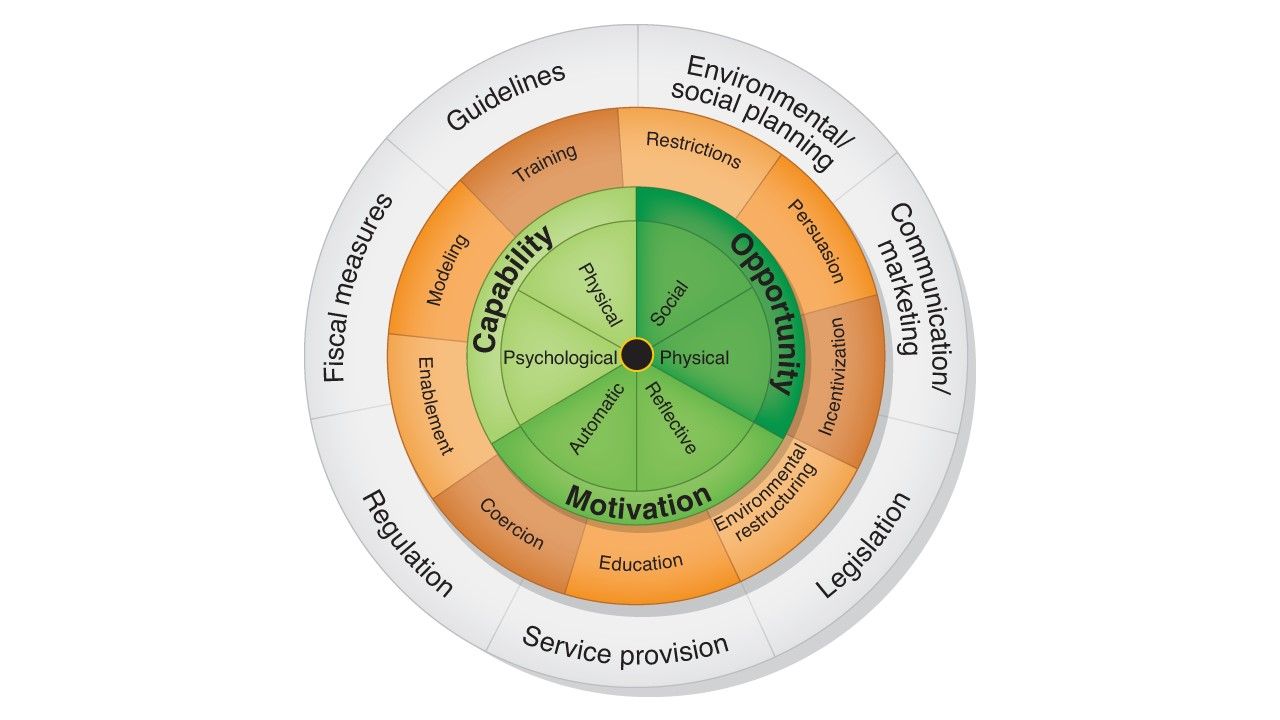
The model is attractively simple. For a behaviour (B) to occur, people need:
- Capability (C): the physical and psychological ability, including knowledge and skills, to perform the behaviour.
- Opportunity (O): a physical and social environment that enables the behaviour.
- Motivation (M): both reflective and automatic processes that make the person want or need to perform the behaviour.
A worked example: PPE during COVID-19
An example from my own experience comes from the 'PPE Helper Programme' introduced at Imperial during the first wave of COVID-19 and subsequently evaluated by Enrique Castro-Sánchez and colleagues. This was a period of unprecedented challenge and strain for an IPC service in a large London NHS hospital group. PPE guidance was changing rapidly, staff were working under intense pressure, and there was widespread concern about PPE availability and personal safety. IPC teams were observing suboptimal PPE practice, daily. We benefited from a behaviour change scientist being seconded to our team as part of COVID-19 staff redeployments. This led us to develop the programme around the COM-B framework.
- Capability. There were genuine knowledge and skills challenges: rapidly changing guidance, uncertainty about transmission, questions about mask fit testing, and variable experience of donning and doffing. The response therefore included personalised education, practical training, explanation of changing guidance and support with safe donning and doffing.
- Opportunity. Staff also faced problems obtaining PPE, unsuitable spaces for putting it on and removing it, heavy workloads, lack of opportunities to practise, physical difficulties wearing PPE and social norms in which suboptimal practice could become normalised. PPE helpers therefore looked at the environment as well as the individual. They assessed obstacles, reported shortages and helped staff identify safer ways to store, use and dispose of PPE.
- Motivation. Staff were frightened. There were concerns around whether recommended PPE was really sufficient. Changing guidance undermined trust. People believed that wearing more PPE was automatically safer. Stress and cognitive load was affecting decision-making, while established PPE habits were proving difficult to change. PPE Helpers listened to concerns, built trust, challenged myths, helped staff solve problems, reinforced good practice and followed up individual questions.
Impact
Over six weeks, PPE helpers made 268 visits to 30 wards. The evaluation included 261 staff questionnaires, with 68% of respondents reporting contact with a PPE helper. Staff who had encountered a PPE helper were significantly more likely to report that they had received enough PPE training, that PPE was immediately available, that their ward had adequate facilities for safe donning and doffing, and that they found it easy to use PPE appropriately. They were also less likely to report anxiety that the PPE provided was insufficient.
The study was a single centre, rapid service evaluation, without a baseline comparison, so we cannot attribute all of these differences directly to PPE helpers. But the COM-B model was a very helpful way to configure the programme, which undoubtedly made things better under very challenging circumstances.
What does this mean for IPC teams?
Sometimes we don't need another educational programme. Or another guideline. Or more auditing. But rather a reconsideration of why staff are not meeting the required standards of care. Understanding this will be the first step towards delivering effective and sustained improvement.
We're looking forward to Dr Giorgia Gon's Insight Webinar all about behaviour change and IPC on Wednesday this week (register here). Hope you can join us!
Subscribe
Subscribe to our email list if you’d like us to let you know about future Journal Clubs, Insight Webinars, and for other updates from IPC Partners.
This website uses cookies to improve your experience. Learn more