

Managing a C. auris outbreak? Take a long, hard look at your shared medical equipment
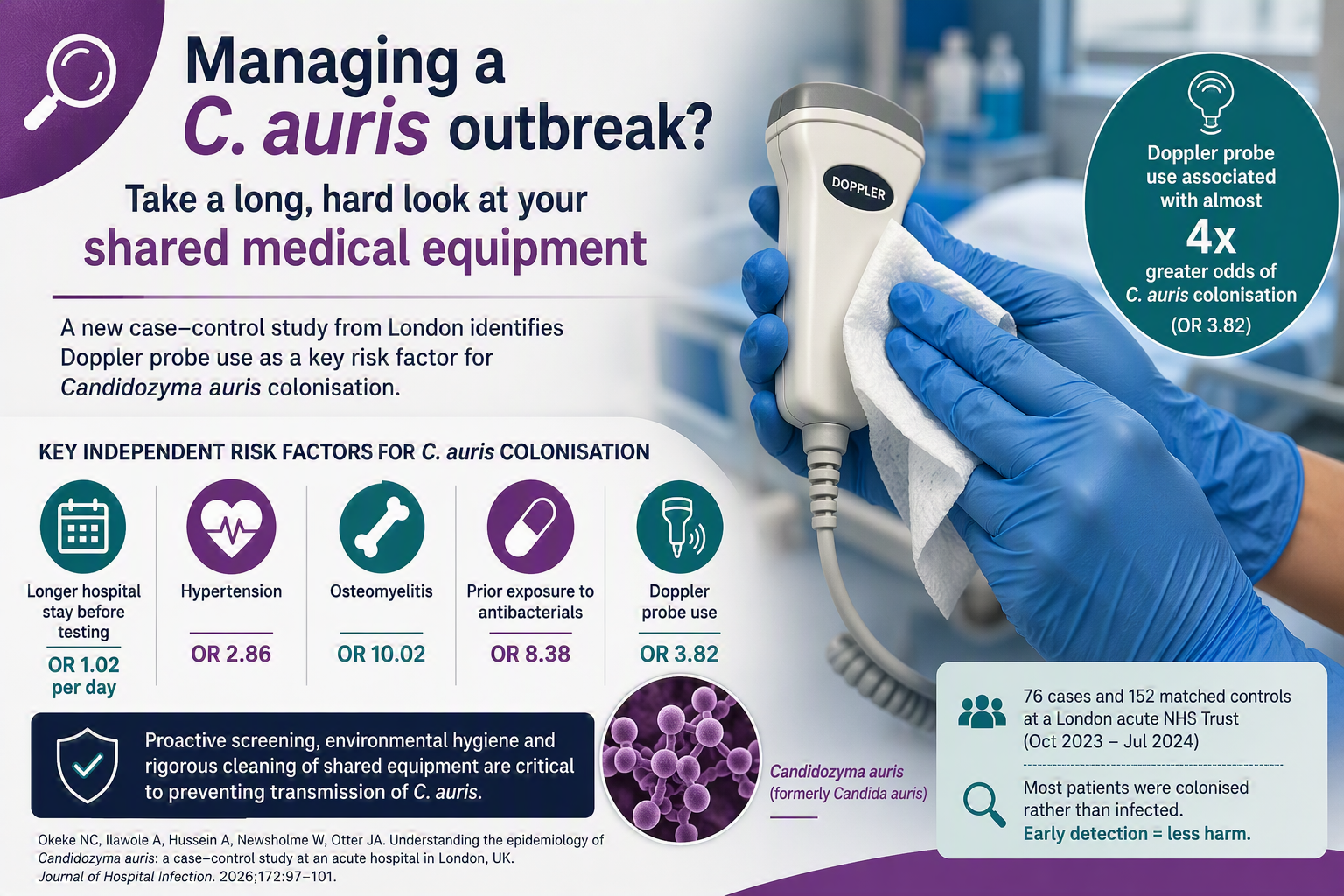
A new case–control study from London sheds light on risk factors for acquisition of one of healthcare’s most challenging emerging pathogens.
Candidozyma auris has become one of the most closely watched healthcare-associated pathogens of the past decade. Known for its ability to persist in healthcare environments, colonise patients for prolonged periods, and resist multiple antifungal agents, C. auris continues to cause outbreaks in hospitals around the world.
A new study published in the Journal of Hospital Infection by my group in London led by the fantastic Dr Nneoma Okeke provides important insight into the epidemiology of C. auris during a large outbreak at a London acute NHS Trust. The findings reinforce some familiar themes, such as the importance of prolonged healthcare exposure and antimicrobial use, but also reinforce the pivitol role of shared medical equipment in the spread of C. auris.
Understanding an emerging threat
The study was conducted during an outbreak that began in September 2023. By July 2024, the hospital had identified 76 patients colonised or infected with C. auris, representing a substantial increase compared with the previous five years, during which only 10 positive samples had been detected. Most positive patients were colonised rather than infected, highlighting the importance of active surveillance programmes in recognising transmission that might otherwise go unnoticed.
To better understand what factors were associated with colonisation, we conducted a matched case–control study involving 76 cases and 152 controls. Cases and controls were matched by specialty, age group and sex, with clinical, demographic and treatment data extracted from electronic health records.
What were the risk factors?
Several factors were independently associated with C. auris colonisation. Perhaps unsurprisingly, patients who spent longer in hospital before being tested were more likely to be colonised with C. auris. Each additional inpatient day before testing increased the odds of a positive screen by approximately 2%. The median time from admission to testing was 22 days for cases compared with just two days for controls.
The study also identified associations with:
- Hypertension (OR 2.86)
- Osteomyelitis (OR 10.02)
- Prior exposure to antibacterial therapy (OR 8.38)
Exposure to antimicrobial agents has long been recognised as a risk factor for colonisation with antimicrobial-resistant organisms. The findings therefore fit with broader understanding of how antimicrobial pressure can influence colonisation dynamics within healthcare settings. In this study, we saw an association between antibacterial use and C. auris colonisation, but we did not see an association with antifungals – this is because very few cases or controls were on antifungals prior to their positive or negative C. auris screen.
Interestingly, the investigators found no significant association between C. auris acquisition and the presence of indwelling devices such as central lines, urinary catheters or drains. This contrasts with some previous studies but may reflect the fact that almost all patients in this cohort were colonised rather than infected.
Shared medical equipment: Doppler probes
The most intriguing finding was the association between C. auris colonisation and Doppler probe use.
Patients exposed to Doppler probes had almost four times greater odds of testing positive for C. auris than controls (OR 3.82). This finding is consistent with other studies that have identified shared medical equipment linked to ongoing outbreaks of C. auris, most notably temperature probes in the Oxford outbreak.
The authors note that Doppler probes come into direct contact with patient skin and that previous studies have demonstrated bacterial contamination of these devices. Because the electronic patient record could not distinguish between handheld and shared Doppler systems, the precise mechanism is uncertain. Nevertheless, the finding raises important questions about cleaning compliance, storage practices, and hand hygiene during device use. We switched to sporicidal peracetic acid-based wipes during the outbreak, suggesting that the issue was unlikely to be related to product efficacy. Instead, inconsistent disinfectant practices or opportunities for indirect transmission may have contributed. So, whose job is it to clean and disinfect a doppler probe? It has to be the user – but this role is not always recognised or accepted in the way that it should be!
Limited clinical impact
Patients colonised with C. auris were no more likely than controls to die during their hospital stay, and they did not experience longer overall lengths of stay. This contrasts with many international studies that have linked C. auris to severe infection, prolonged hospitalisation and increased mortality. The difference is probably because most patients in this outbreak were identified through active screening before invasive infection developed. Some may view this finding as supporting a position of "well there's not much clinical impact, so why are we spending all this time and money on prevention". However, to me, this provides a powerful argument for the value of proactive surveillance programmes. Early identification allows healthcare teams to implement transmission-based precautions, enhanced cleaning and disinfection, and outbreak-control measures before patient harm occurs. Also, there's a broader public angle to C. auris control – if efforts are not made to limit outbreaks then the susceptible population becomes resistant to frontline antifungal agents, and this is not good in the long run!
Strengths and limitations
This study has several notable strengths. It represents one of the few UK case-control studies examining risk factors for C. auris acquisition during a hospital outbreak and includes a relatively large cohort of 76 cases and 152 matched controls. We were able to draw on a comprehensive electronic patient record, allowing assessment of a wide range of demographic, clinical and healthcare exposure variables. The use of matched controls and multivariable logistic regression strengthened the analysis by helping to account for potential confounding factors and identify independent risk factors for colonisation. The study also generated an important and potentially practice-changing hypothesis regarding the role of Doppler probes as a transmission vector, highlighting the value of detailed epidemiological investigation during outbreak settings.
However, several limitations should be considered when interpreting the findings. The study was undertaken retrospectively within a single NHS Trust during an outbreak, which may limit the generalisability of the results to other healthcare settings or endemic situations. Some potentially important risk factors, including travel history and certain exposure data, were unavailable or incompletely captured within the electronic patient record. The vast majority of cases represented colonisation rather than invasive infection, meaning that findings may not be applicable to predictors of clinical disease. In addition, culture-based screening methods were used, which are less sensitive than molecular diagnostic approaches and may have resulted in missed cases or misclassification. Finally, while Doppler probe use was strongly associated with C. auris acquisition, the observational nature of the study means causality cannot be established, and further research is needed to confirm whether these devices directly contribute to transmission.
What does this mean for IPC?
The study reinforces several important lessons for infection prevention and control practitioners:
- Prolonged healthcare exposure remains a key risk factor for C. auris acquisition.
- Active screening programmes are essential for identifying colonised patients and limiting transmission.
- Shared patient-care equipment should be considered a potential source of transmission.
- Cleaning and disinfection processes are just as important as the choice of disinfectant product.
As C. auris continues to emerge globally, identifying and addressing these hidden opportunities for spread will be critical for protecting patients and preventing future outbreaks.
Subscribe
Subscribe to our email list if you’d like us to let you know about future Journal Clubs, Insight Webinars, and for other updates from IPC Partners.
This website uses cookies to improve your experience. Learn more