

Rethinking respiratory precautions
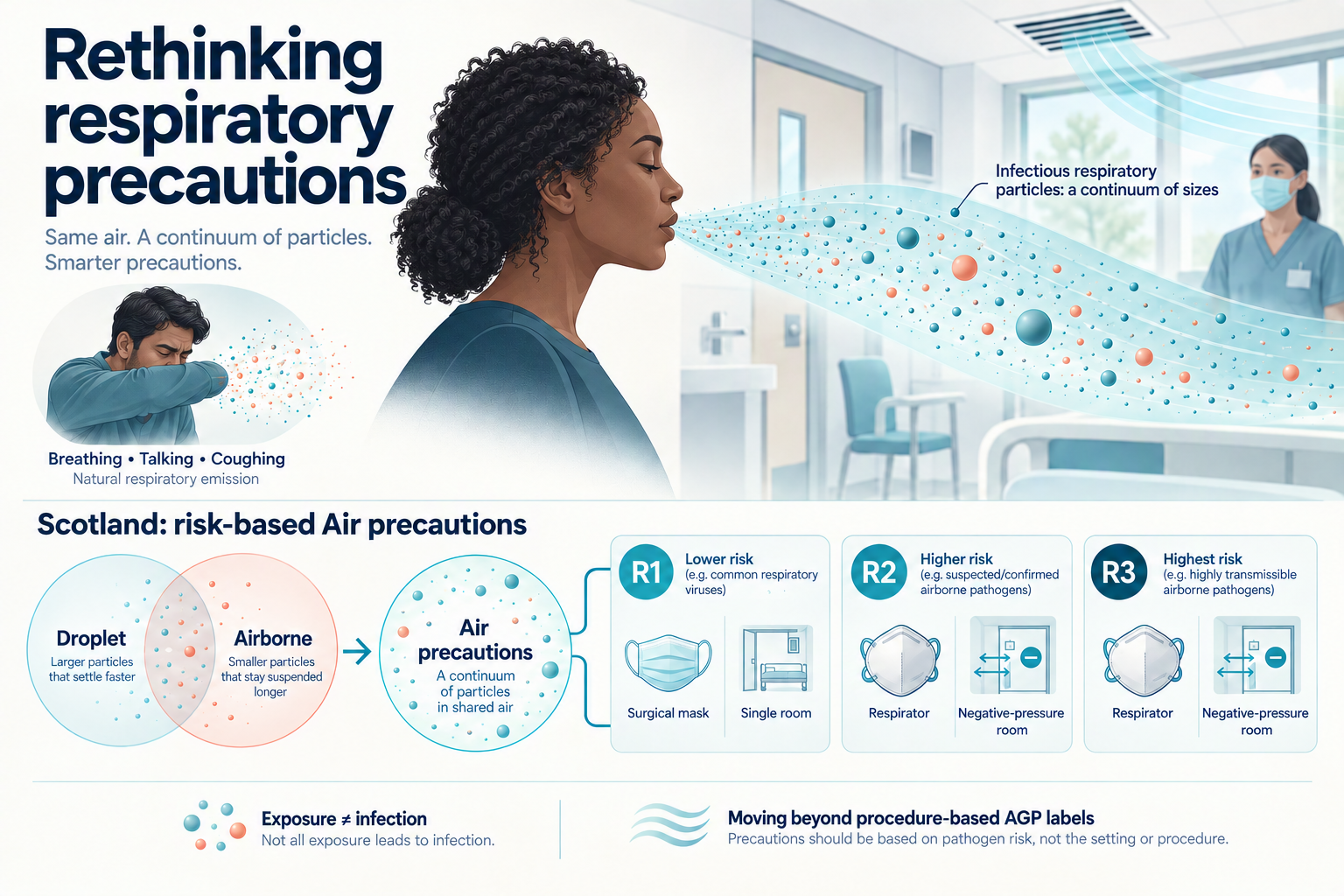
I've spent the last couple of days in Glasgow, Scotland at the FIS conference. One of the most interesting sessions I attended at FIS was about rethinking respiratory transmission-based precautions. The discussion reflected an important shift in how we describe respiratory transmission, with implications for IPC practice.
What do we mean by transmission?
Before getting into the changes, we need to take view on a fundamental question: what do we actually mean by transmission? I was a member of the group that developed the 2024 WHO proposal terminology for pathogens that transmit through the air. I was struck during those discussions how people from different disciplines didn't necessarily use “transmission” to mean the same thing.
Many colleagues with an engineering background tended to describe transmission as the movement of a viable pathogen from one person to another (which is not unreasonable, as a definition!). However, those of us coming from an infection background tended to think of that as exposure. For us, transmission went a step further: the pathogen reaches another person and initiates infection – needing to be present in a sufficient quantity and delivered in the right way to overcome host defenses.
Detecting more infectious respiratory particles, or even viable organisms, demonstrates the potential for exposure, but doesn't necessarily demonstrate increased risk of infection. This distinction becomes important when we try to define transmission routes and determine the precautions required to interrupt them.
Moving beyond droplets and aerosols
Traditionally, IPC has divided transmission-based precautions into Contact, Droplet and Airborne. But things have moved on. WHO now uses the term 'infectious respiratory particles' (IRPs), recognising that particles containing infectious pathogens exist across a continuum of sizes rather than fitting neatly into “droplet” and “aerosol” categories (for the record, we have always recognised the continuum of particle sizes emitted during a respiratory infection, and had questions about what this means for IPC - it's not as if we started asking these questions during the pandemic!). The WHO report on pathogens that transmit through the air provides the scientific framework for this change.
Scotland has now translated this thinking into IPC practice. The Scottish NIPCM has rationalised Contact, Droplet and Airborne precautions into two categories: Contact and Air, supported by a comprehensive set of literature reviews.
Not all “Air” is the same
Moving away from Droplet precautions doesn't mean treating every respiratory infection like measles or pulmonary tuberculosis. Instead, Scotland stratifies pathogens within Air precautions into R1, R2 and R3 categories according to risk. R1 requires a surgical mask and single-room isolation, whereas R2 and R3 require a respirator and negative-pressure isolation room.
Interestingly, this fairly radical reframing will result in relatively little change at the bedside. The pathogens in R1 are essentially those for which we currently use Droplet precautions, so much of the frontline practice will be unchanged.
Farewell AGPs
The new framework also challenges the concept of aerosol-generating procedures (AGPs). The Scottish reviews found that coughing appeared to be an important mechanism for increasing infectious respiratory particle emission during certain procedures. This rather undermines the concept of AGPs as a predictor of increased infection risk, since coughing is a normal human activity, and particularly common in somebody with a respiratory infection! Scotland has therefore removed AGPs from its guidance. This is potentially the most noticeable practical change: undertaking a procedure previously labelled an AGP on somebody with an R1 infection doesn't automatically trigger escalation to higher-level Air precautions.
Where next?
My reading of the FIS discussion was that England seems to be travelling in a similar direction, although we'll need to see where the English NIPCM eventually lands. For me, Scotland has landed in a good place, with the guidance now more in keeping with the science of transmission.
Subscribe
Subscribe to our email list if you’d like us to let you know about future Journal Clubs, Insight Webinars, and for other updates from IPC Partners.
This website uses cookies to improve your experience. Learn more