

Rethinking the language of AMR: why our metaphors matter more than ever
Ahead of next week's (20th May at 3PM) IPC Partners journal club (which you can register for here), I have looked at one of the papers which one of our guest Clare Kilpatrick, will run through: Risk communication about antimicrobial resistance: a content analysis of metaphor use in global public discourse.
The areas covered in the paper of personal interest to me, firstly the silent pandemic of AMR and its threat to safety and secondly how as IPC professionals we communicate AMR to the patients and the public.
AMR is one of the biggest global health threats we face yet public understanding remains low. The analysis in this study of more than 2,000 metaphorical references across websites, action plans, newspapers and social media suggests reasons why: the metaphors we use may be confusing, misleading or counterproductive.
Why this matters
Metaphors influence how people think and behave. When AMR is framed as a war, people expect a decisive victory. When it’s described as an apocalypse, they feel powerless. When it’s “silent” or “creeping”, it feels distant and abstract.
For IPC teams, this matters because behaviour change depends on accurate mental models. If our language reinforces misconceptions (such as the idea that the body becomes resistant), we make our own work harder.
What the study tells us
The study search spanned four different types of sources: (1) webpages of non-profit organisations and government bodies, (2) electronic national action plans on AMR, (3) online records of newspaper articles, and (4) social media posts on Twitter/X.
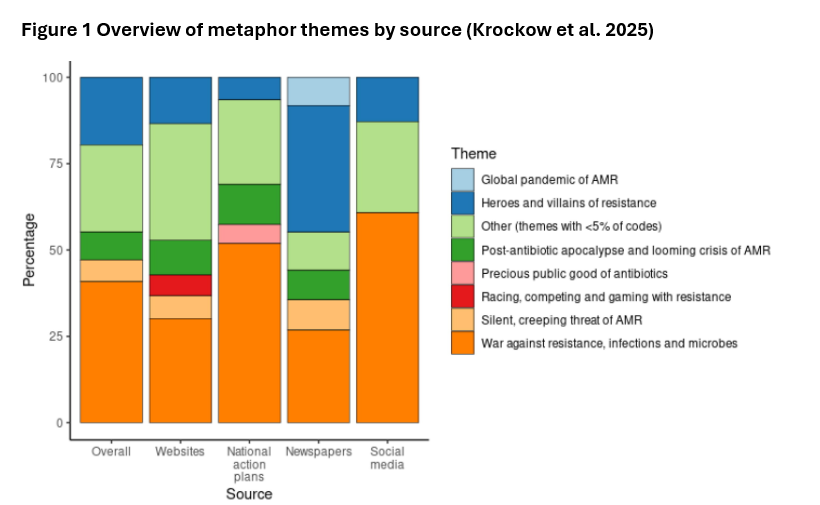
The subsequent data analysis identified four dominant metaphor types (Figure1):
- War - “fighting superbugs”, “combatting resistance”, “our dwindling antibiotic arsenal” which imply a winnable battle, not a long-term evolutionary process.
- Heroes and villains - superbugs as criminals or villains; antibiotics as superheroes. This oversimplifies biology and centres antibiotics as the main solution.
- Apocalypse - “Drugmageddon”, “dark ages”, “nightmare scenario”. Attention-grabbing, but often paralysing.
- Silent, creeping threat - invisible, hidden, slow-moving which makes AMR feel distant, not urgent.
The authors conclude that many of these metaphors are “inapt or theoretically problematic”, failing to support meaningful understanding or behaviour change.
What this means for IPC teams
IPC relies on people understanding why prevention and stewardship matter. If our metaphors are dramatic but inaccurate, we risk:
- reinforcing misconceptions
- centring antibiotics instead of infection prevention
- undermining long-term behaviour change
We need language that supports systems thinking, not fear or heroics.
Where we go from here
The study calls for metaphors that are apt, novel and explanatory, ones that help people understand AMR as a dynamic, ecological challenge.
Better alternatives include:
- AMR as a pressure system - resistance builds like pressure in a pipe.
- Antibiotics as a shared utility - a public good requiring careful management.
- Microbes as part of an ecosystem - not enemies, but partners that can become disruptive.
- Stewardship as infrastructure - antibiotics as fire extinguishers: essential, but not for routine use.
These metaphors shift the narrative from conflict to co‑existence, and from panic to practical action.
Subscribe
Subscribe to our email list if you’d like us to let you know about future Journal Clubs, Insight Webinars, and for other updates from IPC Partners.
This website uses cookies to improve your experience. Learn more