

Sink splash zone 2.0
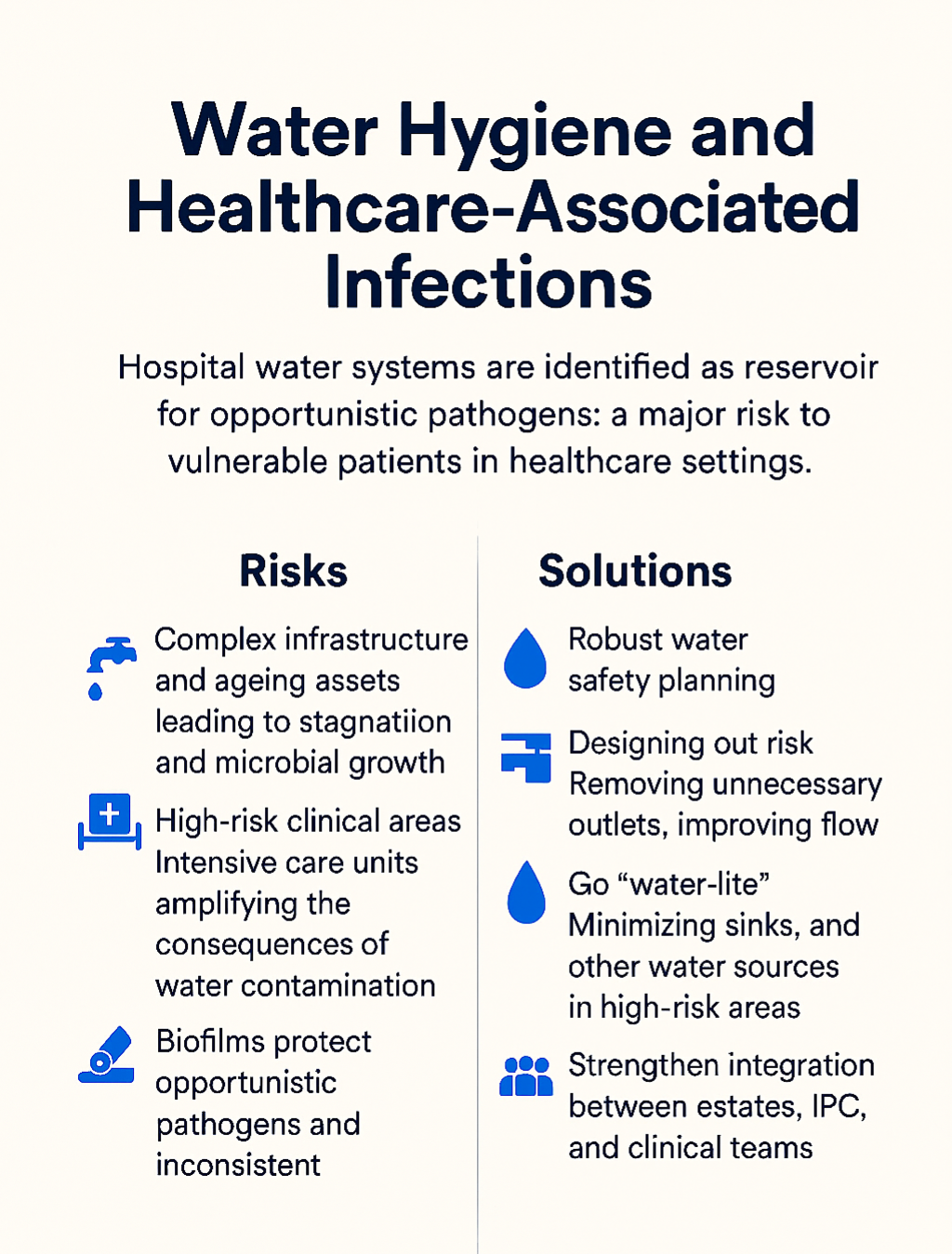
To mark World Hand Hygiene Day 2026, I’ve put together a blog based on the brilliant followup to Mark Garvey’s sink splash zone. This time, in a new publication in the Journal of Hospital Infection, Mark and his team not only measure how far the drops splash from clinical hand wash basins, but also culture them to see what grows...
Water is essential to healthcare, but it is also an under‑recognised source of infection risk. Around one in five HCAIs are thought to have a water component, although this estimate is just an approximation – we really need good data to help us to understand and scale this risk.
Hospital water systems are complex, warm, nutrient‑rich environments that can support microbial growth and biofilm formation. Sink traps in particular provide ideal conditions for opportunistic pathogens and antimicrobial resistance genes to persist and evolve. They are also notoriously difficult to decontaminate. Over time, these reservoirs can become long‑term sources of healthcare‑associated pathogens, including carbapenem‑resistant organisms.
The splash zone problem
Patients and staff can be exposed to waterborne organisms through a variety of routes, including direct contact with water outlets and indirect exposure via surfaces, equipment and aerosols. Previous work has shown that running taps can generate splashing and droplet dispersion well beyond the immediate sink area. In an earlier study, Mark and his team demonstrated that water from a clinical hand wash basin could splash up to two metres from the tap, placing a wide range of patient care equipment firmly within the so‑called “splash zone”.
This raises an important question: what is actually being dispersed when a tap is running? If the sink drain harbours resistant organisms, could these be splashed out into the surrounding clinical environment?
Sampling the air around a running tap
To explore this, environmental air sampling was undertaken around a clinical hand wash basin in a burns shock room within the critical care unit at Queen Elizabeth Hospital Birmingham (QEHB), one of the largest tertiary centres in the UK.
An air sampler was positioned around one metre from the tap, well within the previously defined splash zone, and samples were collected both with the tap running and with the tap turned off. All Gram‑negative organisms recovered were identified, and any carbapenemase‑producing Enterobacterales (CPE) were investigated in detail using whole‑genome sequencing.
When the tap was not running, no Gram‑negative organisms were recovered. When the tap was running, however, a diverse range of Gram‑negative bacteria were cultured from the air. These included Enterobacter cloacae, Enterobacter kobei, Enterobacter asburiae, Citrobacter freundii, Pseudomonas aeruginosa and Sphingobacterium multivorum - all organisms with recognised potential to cause HCAI, particularly in vulnerable patients.
A carbapenem‑resistant organism in the splash zone
Most concerning was the identification of a carbapenemase‑producing Citrobacter freundii isolate recovered during splash‑mediated sampling. Genomic sequencing showed that this organism carried the blaKPC‑2 carbapenemase gene on a conjugative plasmid. This plasmid proved to be a close structural variant of pQEB1, a carbapenem resistance plasmid lineage that has previously been implicated in clinical infections and patient colonisation at QEHB. Variants of pQEB1 have been identified across multiple Enterobacterales species and wards, including critical care areas.
This finding adds to growing evidence that hospital plumbing systems are likely to actively contribute to the persistence and spread of clinically important antimicrobial resistance.
Why this matters for IPC
This was a single sink in a single location, and further work is needed to explore how representative these findings are across different wards, sink designs and water outlets. However, we now have evidence that running taps can aerosolise or splash organisms carrying clinically relevant resistance genes into the surrounding environment, and so sink placement, sink use and what we do (or don’t do!) within splash zones all matter.
For IPC teams, this reinforces several key principles:
- Hospital sinks and drains should be treated as potentially high‑risk reservoirs, particularly in critical care and high‑dependency settings.
- The space around sinks should be considered at risk of contamination. Storing equipment, preparing invasive procedures, or placing patient items within splash zones may increase transmission risk.
- Water safety, IPC and estates teams need to work closely together. Sink design, tap flow rates, drainage configuration and mitigation technologies all influence risk.
- Molecular data adds important insight. Linking environmental isolates to clinical resistance plasmids helps us understand transmission pathways that would otherwise remain invisible.
What next?
Factors such as tap flow rate, hand hygiene behaviour, point‑of‑use filtration and sink decontamination strategies may all influence splash‑mediated dispersion. Novel approaches, including chemical disinfection of siphons and in‑drain UVC devices, show promise but require careful evaluation in real‑world healthcare settings. This study underlines that water, drains and splash zones deserve sustained attention as part of a modern IPC strategy. As we continue to grapple with antimicrobial resistance, we simply cannot afford to overlook environmental reservoirs.
Subscribe
Subscribe to our email list if you’d like us to let you know about future Journal Clubs, Insight Webinars, and for other updates from IPC Partners.
This website uses cookies to improve your experience. Learn more