

The top 5 trends in surgical site infection prevention: looking towards 2036
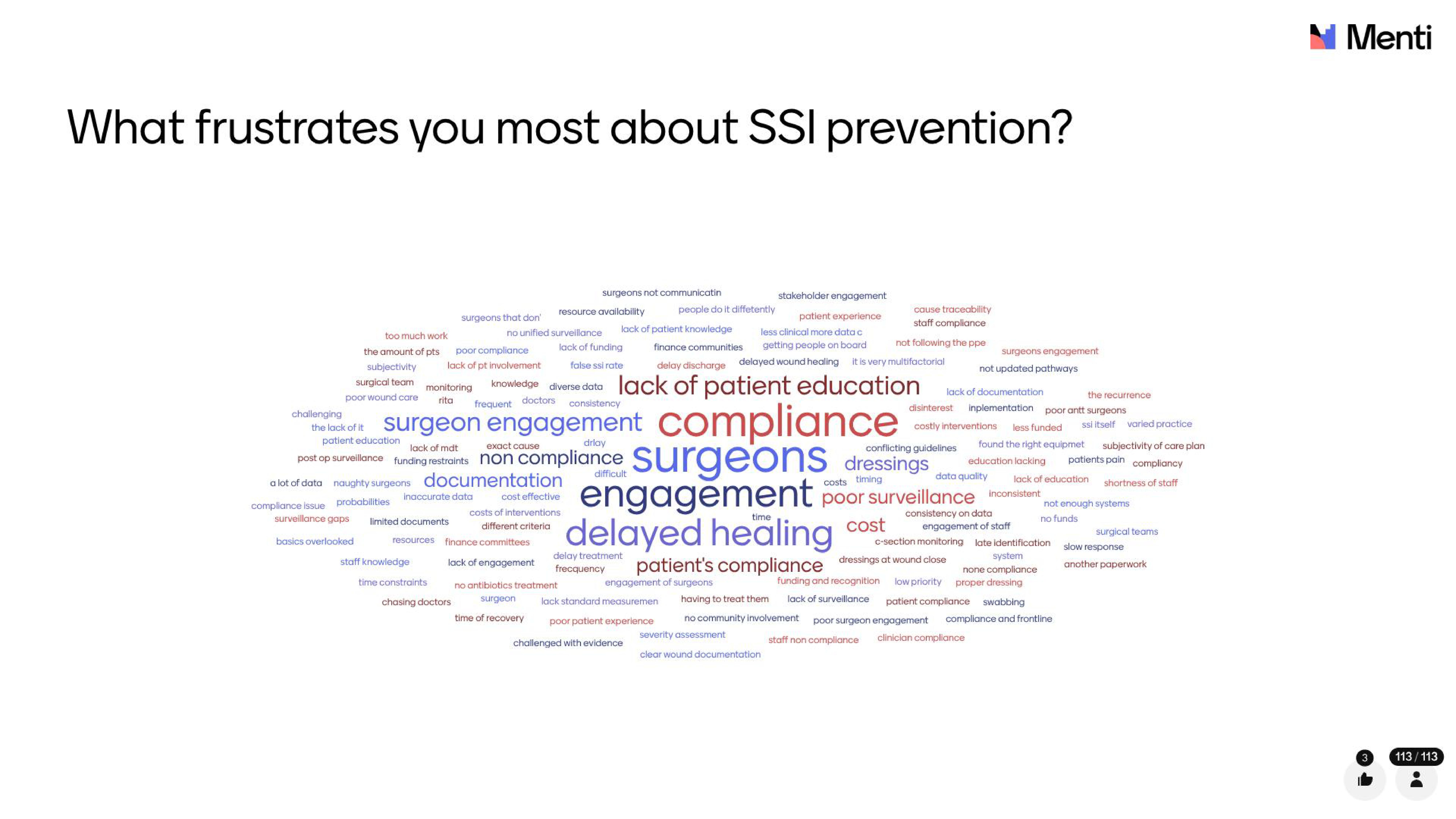
Last week, I had the pleasure of delivering the closing keynote at the ‘Future of Surgical Site Infection Prevention’ Conference in London, where I was asked to reflect on the the top 5 trends in SSI prevention. Looking out to 2036 is, of course, speculative. But when you look at emerging evidence, changing healthcare priorities, technological advances, and some of the challenges we still haven't solved, several themes stand out. The future of SSI prevention will be a broader, more personalised approach that puts patients, physiology, value and innovation at the centre of care.
I started by asking the audience what frustrated them most about SSI prevention (see the word cloud above). Somewhat disappointingly, surgeons came out as the biggest theme (my apologies to any surgeons reading this – don't shoot the messenger). So, we still have a long way to go in creating the necessary relationships with key stakeholders to reduce the risk of SSI and surgical infection more generally. Compliance was another striking theme from the word cloud. We can have the best policies and guidelines in the world, but they mean nothing without effective implementation. Lack of patient education was another theme from the audience feedback. It goes without saying that patients have a vested interest in preventing SSIs, and so let’s see what we can do to make them partners in prevention!
1. Cost and value will become impossible to ignore
SSI prevention has always been about improving patient outcomes, but increasingly it will also be about demonstrating value. Healthcare systems around the world face unprecedented financial pressures. And so we need to become even better at understanding the true cost of surgical complications. SSI increases length of stay and healthcare expenditure, and it affects patient experience, organisational reputation, antimicrobial use and antimicrobial resistance.
Sustainability is another dimension that is, rightly, attracting growing attention. Recent work examining vascular surgery patients showed that SSI increased carbon emissions more than sixty-fold compared with patients who did not develop infection. Most of this environmental and financial burden was driven by readmission and management of complications.
As healthcare increasingly focuses on value-based care, interventions that prevent SSI will need to economic and environmental effectiveness in addition to clinical impact.
2. A renewed focus on homeostasis
Are we too focused on checklist-driven interventions while paying less attention to the patient's physiology, which is arguably the biggest factor in determining infection risk? Normothermia provides an excellent example. It remains a cornerstone of many international guidelines, yet it often receives surprisingly little attention compared with newer technologies and interventions.
Hypothermia impairs tissue oxygenation and immune function, roughly doubles the risk of SSI, increases blood loss and transfusion requirements, raises the risk of adverse cardiac events, and delays recovery. And hypothermia is just one aspect of homeostasis: recent analyses of international guidelines highlight the importance glycaemic control, oxygenation, fluid balance and thermal management.
By 2036, I expect the conversation to shift from individual interventions towards optimisation of the whole physiological environment in which surgical procedures takes place.
3. Patients will become active participants in prevention
Traditionally, SSI prevention has been seen as something done to patients. I sincerely hope that in the future, it will increasingly be done with patients. Many of the strongest risk factors for SSI are patient-related and potentially modifiable. Smoking, obesity, diabetes control, nutrition, skin health and physical fitness all influence infection risk. Yet these factors often sit outside traditional SSI programmes.
The concept of "pre-operative optimisation" is gaining momentum. Evidence suggests that smoking cessation programmes before surgery reduce postoperative complications, shorten hospital stays and are frequently cost-saving. Similarly, weight-loss interventions before bariatric surgery reduce complications and readmissions. Patient engagement is important after surgery too. One study demonstrated that a simple "photo at discharge" intervention was associated with lower rates of readmission for SSI, helping patients identify complications earlier and seek appropriate advice.
The future of SSI prevention may therefore look much more like population health, empowering patients to improve their overall health before surgery and participate actively in their recovery afterwards.
4. Precision prevention will replace one-size-fits-all approaches
Many current SSI prevention strategies are intentionally broad. We apply the same measures to almost everyone undergoing a particular procedure. While this has delivered significant gains, it may not represent the end point of progress. Emerging technologies are creating opportunities for precision prevention.
Rapid diagnostics may enable identification of relevant pathogens and antimicrobial resistance markers before surgery. Screening and targeted decolonisation strategies for Staphylococcus aureus already represent an early example of this approach, particularly in orthopaedic and cardiac surgery. At the same time, predictive analytics and artificial intelligence are opening the possibility of dynamic, patient-specific risk prediction. Recent studies suggest AI models can identify patients at high risk of SSI with impressive accuracy and, in some settings, outperform clinician assessment.
By 2036, the idea of providing identical prevention strategies to every patient may seem outdated. Instead, prevention bundles may be tailored according to individual risk, microbiology, physiology and surgical characteristics.
5. Innovation will accelerate
There is ongoing interest in novel approaches to SSI prevention and surveillance. Artificial intelligence is attracting particular attention, not only for risk prediction but also for surveillance. Most SSIs occur after discharge, yet post-discharge surveillance remains challenging and resource-intensive. Early studies suggest large language models may be able to support or automate aspects of case finding with accuracy comparable to human reviewers.
At the same time, entirely new preventive technologies are emerging. One recent study of nasal photodisinfection reported substantial reductions in SSI following skull base surgery, offering a potential non-antibiotic alternative to traditional decolonisation approaches.
The challenge for all of us is to remain open to innovation while maintaining rigorous standards of evaluation.
Looking ahead
The conference programme highlighted many of the issues shaping the future of SSI prevention, from antimicrobial resistance and personalised care to digital surveillance and patient-centred approaches. I hope that by 2036, we will have improved our engagement with key partners in prevention (from patients to surgeons), have better and broader surveillance, a big focus on patient health and homeostasis, and implemented some novel approaches.
Subscribe
Subscribe to our email list if you’d like us to let you know about future Journal Clubs, Insight Webinars, and for other updates from IPC Partners.
This website uses cookies to improve your experience. Learn more