
Water hygiene & HCAI: risks and solutions
I've put together this blog in preparation for next week's Insight Webinar with Dr Jessica Martin, all about water hygiene! While attention often focuses on hand hygiene, medical devices, and antimicrobial stewardship, water systems are an equally critical, and sometimes under‑recognised, source of infection risk within healthcare environments.
Hospital water systems are extensive, complex, and inherently difficult to manage. When control measures fail, they can become reservoirs for opportunistic pathogens, placing vulnerable patients at significant risk. Understanding these risks, and, crucially, how to manage them effectively, is central to modern IPC.
Why water hygiene matters in hospitals
HCAIs are infections acquired as a result of healthcare exposure, often affecting patients with weakened immune systems or those undergoing invasive procedures. Water systems intersect with patient care in countless ways: handwashing, showers, clinical sinks, ice machines, and medical equipment that relies on water.
Pathogens such as Legionella pneumophila and Pseudomonas aeruginosa are well‑recognised water‑associated organisms. In fact, I think we could do with a new acronym for these water-associated opportunistic pathogens – WAOPs perhaps! When hospital water systems are poorly designed, inadequately maintained, or inconsistently monitored, these organisms can proliferate and be transmitted via aerosols, splashes, or direct contact with contaminated outlets, as demonstrated in reviews of water‑associated outbreaks in healthcare settings (Kanamori et al., Clinical Infectious Diseases).
What makes water hygiene particularly challenging is that risks are often invisible. A system may appear compliant on paper while harbouring biofilms, stagnation, or temperature control failures that allow pathogens to persist.
Key water hygiene risks linked to HCAIs
Several recurring risk factors are consistently supported by the evidence base:
- Complex infrastructure and ageing assets. Older hospitals often contain redundant pipework and dead legs, increasing stagnation and biofilm formation - risks explicitly addressed in Health Technical Memorandum (HTM) 04‑01 for the design, installation, and operation of healthcare water systems (HTM 04‑01, Parts A and B).
- High‑risk clinical areas. Intensive care units, neonatal units, and haematology wards house highly susceptible patients, amplifying the consequences of even low‑level water contamination. Evidence from UK ICUs shows that sinks and taps can act as reservoirs for P. aeruginosa, with splashing and environmental contamination contributing to transmission (Garvey et al., Journal of Hospital Infection). Also, whilst there is a ‘concentration’ of high-risk patients in these clincial areas, a patient with high-risk for water-associated HCAI can turn up pretty much anywhere in the hospital; this is a big challenge, because where best to focus our control measures?
- Inconsistent monitoring and ownership. Water safety requires coordinated input from estates, IPC, microbiology, and clinical teams. Where responsibilities are unclear, gaps in assurance inevitably appear - a recurring theme in outbreak investigations linked to hospital water systems (Kanamori et al.).
- Biofilms and opportunistic pathogens. Once established, biofilms protect microorganisms from disinfectants and temperature control, making eradication difficult without targeted intervention. The role of biofilms in sustaining Pseudomonas aeruginosa within hospital water systems is well described in the literature (Walker & Moore, Journal of Hospital Infection).
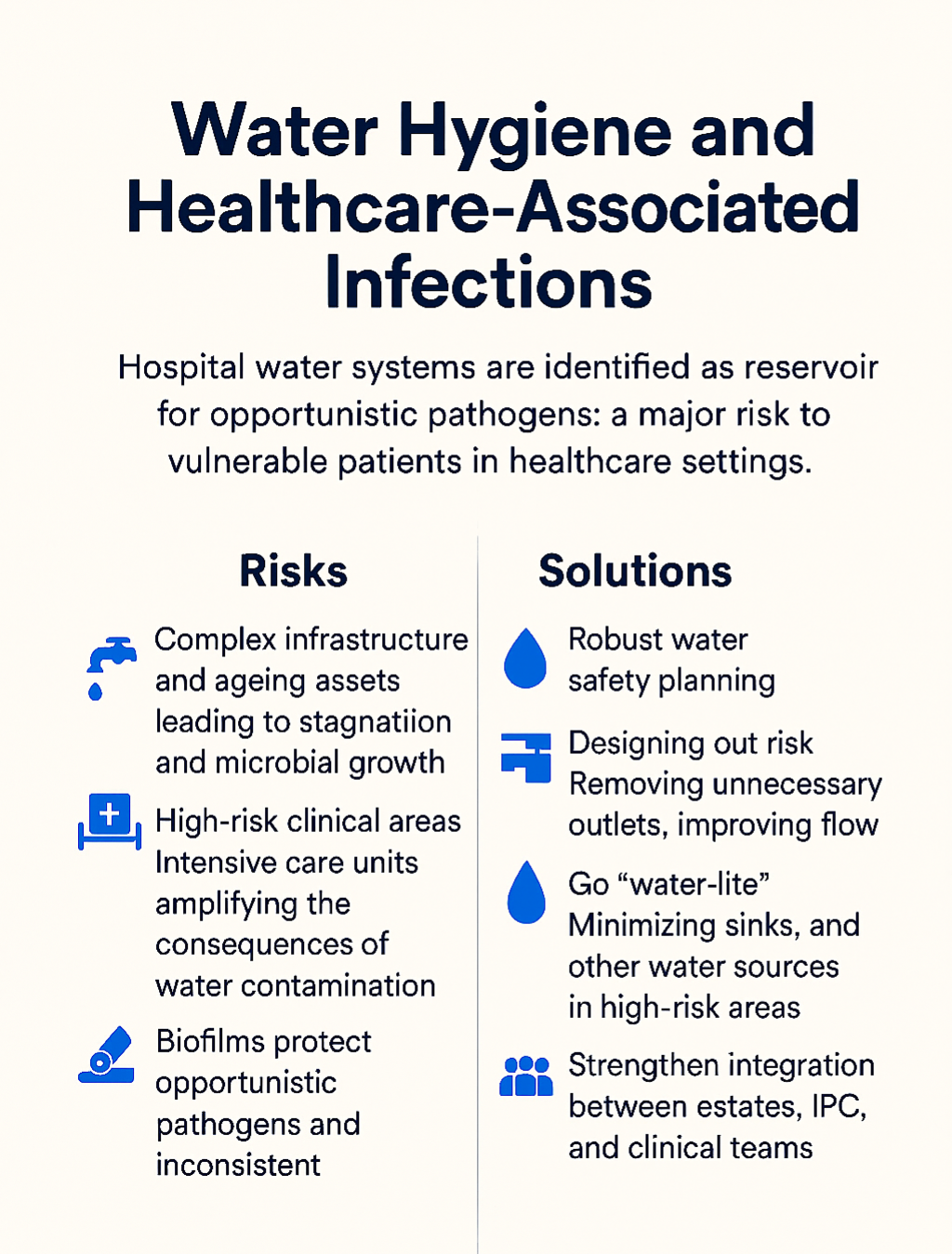
Infographic: Water hygiene risks and solutions summarised
Moving from compliance to control: practical solutions
Effective water hygiene management is not about chasing test results; it is about understanding risk and applying proportionate, evidence‑based controls.
- Robust water safety planning. A live, risk‑based water safety plan (informed by system knowledge rather than generic templates) is fundamental and aligns with UK requirements set out in HTM 04‑01, including the establishment of Water Safety Groups and Water Safety Plans (HTM 04‑01, Parts A and B).
- Targeted monitoring and interpretation. Sampling should be strategic, not routine for its own sake. Results must be interpreted in clinical context, with microbiology and IPC teams actively involved in decision‑making, particularly in augmented care areas as outlined in (HTM 04‑01 Part C). The advent of continuous water temperature and flow monitoring devices is likely to shape the future of this aspect of water hygiene risk management (Snell et al., Journal of Hospital Infection).
- Designing out risk. Where possible, eliminating unnecessary outlets, improving flow, and selecting fittings designed to reduce stagnation and splash can significantly lower long‑term risk. Engineering interventions targeting water outlets have been associated with reductions in P. aeruginosa contamination and clinical isolates in ICUs (Garvey et al., Journal of Hospital Infection).
- Going “water‑lite”. An increasingly important and complementary strategy is reducing reliance on water in high‑risk clinical areas. “Water‑lite” (sometimes called “water-safe”) approaches focus on minimising sinks, drains, and other water outlets close to vulnerable patients, and replacing water‑based practices with safe, effective alternatives where appropriate. Evidence from intensive care settings suggests that this approach can reduce HCAI related to water-associated pathogens (Inkster et al., Journal of Hospital Infection).
- Stronger integration between teams. Some of the most effective improvements come from better communication between estates, IPC, and clinical services, ensuring that water risks are understood as patient safety risks, not just engineering issues.
- Learning from incidents and reviews. Independent reviews and outbreak investigations consistently demonstrate the value of identifying blind spots, challenging assumptions, and translating guidance into site‑specific action (Kanamori et al.).
Summary
Hospitals will always be complex, high‑risk environments. Water systems, by their nature, will never be sterile. The goal of water hygiene is therefore control, not elimination, and, increasingly, thoughtful reduction of exposure where water is not essential.
By shifting the focus from reactive sampling to proactive risk management, healthcare organisations can make meaningful progress in reducing water‑associated HCAIs and improving patient safety overall.
Subscribe
Subscribe to our email list if you’d like us to let you know about future Journal Clubs and for other updates from IPC Partners.
This website uses cookies to improve your experience. Learn more