

CPE: our biggest threat
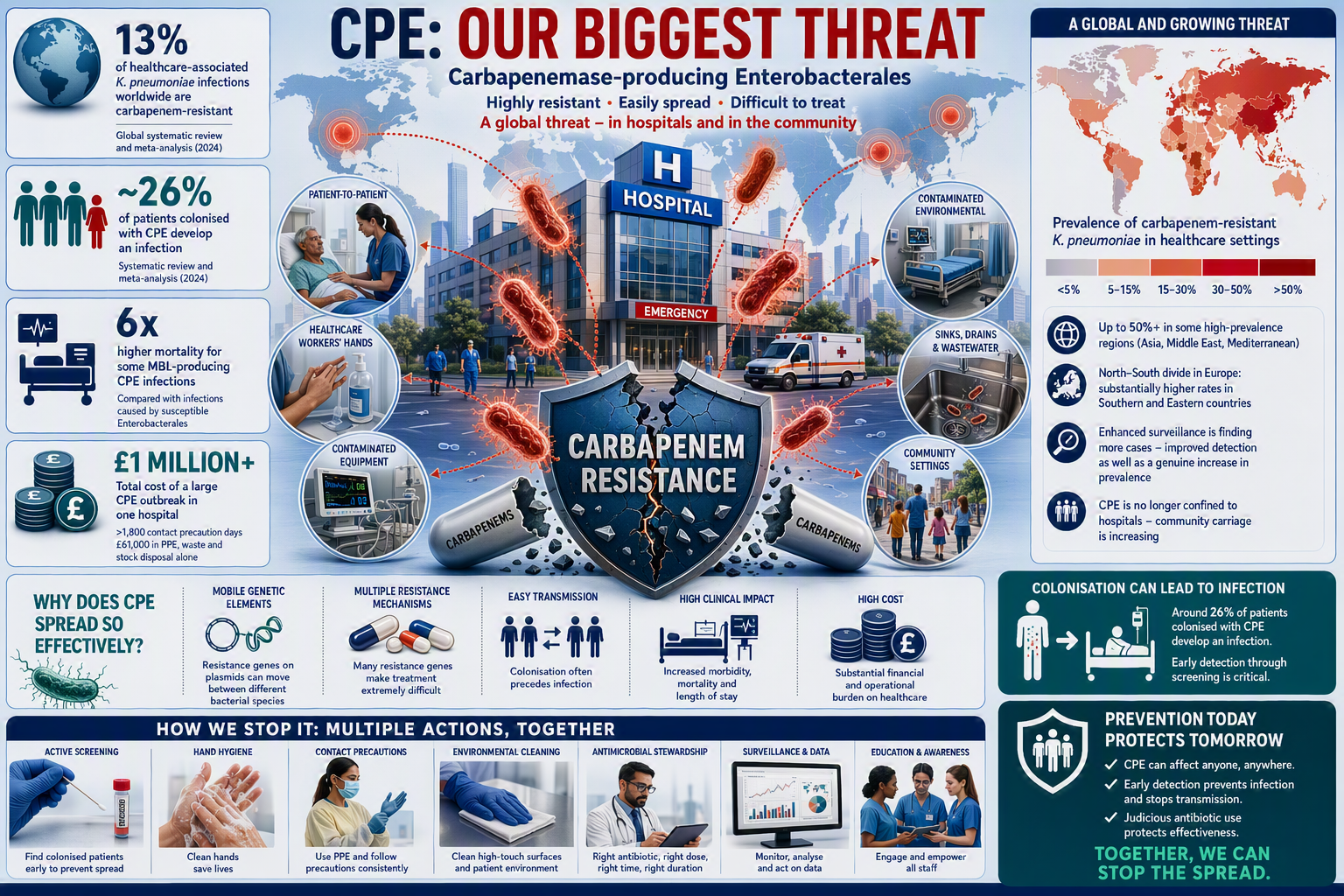
Antimicrobial resistance (AMR) is often described as a slow-moving pandemic (see here for some discussion about how we can optimise our language about describing AMR!). Among the many resistant organisms that keep us awake at night, none present as formidable a challenge as CPE.
For those working in healthcare, CPE has become synonymous with difficult outbreaks, limited treatment options, complex screening programmes and significant operational disruption. Even worse than this though: there's growing evidence that in some parts of the world, CPE is gradually establishing itself in community settings, adding another layer of complexity and recalcitrance to an already challenging problem.
This blog sets out to answer three questions: What's the problem? How bad is it? And how do we stop it?
What's the problem?
At its core, the problem is resistance to antibiotics. Carbapenems are among the most important antibiotics available for treating severe Gram-negative infections. When Enterobacterales such as Klebsiella pneumoniae, Escherichia coli and Enterobacter cloacae become resistant to carbapenems, treatment options become increasingly limited and clinical outcomes worsen.
But resistance is only part of the story. CPE combines several characteristics that make it particularly concerning. Unlike pathogens such as MRSA or VRE, resistance can be encoded by multiple genes, carried by mobile genetic elements, and transferred between different bacterial species. CPE can affect patients both inside and outside healthcare settings and has the potential to impact a broad range of patient groups rather than a narrowly defined at-risk population.
The result in what you could describe as a 'perfect storm' of extensive antimicrobial resistance, significant clinical impact, rapid spread, and substantial financial costs to healthcare systems
The outbreak lessons we should never forget
I have spent much of my career studying multidrug-resistant Gram-negative bacteria, including a large outbreak of NDM-producing Klebsiella pneumoniae in London. The outbreak was detected on pretty much day 1 of my new job in the NHS in London, so it was a bit of a baptism of fire! During that outbreak, 40 patients were identified. The majority were found through screening rather than clinical cultures, demonstrating the critical role of surveillance in identifying hidden transmission. Interestingly though, 14 of those patients initially identified through screening subsequently developed positive clinical cultures. This is consistent with a systematic review and meta-analysis showing that CPE is uniquely able to transition from colonisation to infection compared with it's Gram-negative peers. transition from colonisation to infection compared with it's Gram-negative peers.
The hidden economic burden of CPE
Beyond the clinical impact, the operational consequences of the outbreak were substantial. More than 1,800 contact precaution days were generated during management of the outbreak, costing over £61,000 in gloves, aprons, waste management and stock disposal alone. The total cost of the outrbeak was around £1m.
And these figures almost certainly do not capture the true cost. Direct expenditure includes screening programmes, enhanced cleaning and disinfection, personal protective equipment, antimicrobial treatment and environmental decontamination. However, some of the greatest costs arise from lost opportunities: ward closures, bed restrictions, staff time and cancelled elective activity.
When healthcare systems are already under immense pressure, preventing outbreaks makes both clinical and economic sense. However, it's difficult to justfity investment in prevention when financial times are hard.
How bad is it?
Short answer: very bad. If you have a serious CPE infection in the ICU compared with a carbapenem-susceptible infection, you are twice as likely to die. If you have the misfortune of having an infection due to a CPE producing an MBL carbapenemase (including NDM, VIM, and IMP), you are almost 6x more likley to die.
A global and growing threat
Recent global analyses demonstrate widespread carbapenem-resistant Klebsiella pneumoniae across many regions of the world. The study estimated that approximately 13% of healthcare-associated K. pneumoniae infections worldwide are carbapenem-resistant, although prevalence varied dramatically by region. In some countries with endemic transmission, rates exceeded 30–50%, whereas much lower levels were reported in Northern Europe and other low-prevalence settings. These findings underline that carbapenem resistance has become a major global patient-safety threat.
Across Europe, we continue to observe a striking "north-south divide", with some countries experiencing substantially higher levels of carbapenem resistance than others. Several factors may contribute, including antibiotic consumption, healthcare infrastructure, infection prevention resources and broader system-level pressures.
Meanwhile, enhanced surveillance has revealed that the burden of CPE is growing. As screening programmes become more comprehensive, healthcare organisations are finding more cases. In many settings, increasing detection reflects improved surveillance rather than simply increasing transmission. As the saying goes: seek and ye shall find. However, this should not detract from the genuine and inexorable increase in CPE prevalence.
CPE is not just a hospital problem anymore
Perhaps the most concerning development is the growing evidence of community carriage. Studies from several countries have identified CPE in community populations with prevalence estimates ranging from extremely low levels in the UK through to substantially higher rates in regions where carbapenemase-producing organisms are more established. A recent systematic review suggests that community carriage in the UK remains relatively uncommon, which is encouraging. However, experience from other countries demonstrates how rapidly the epidemiology can change. For example, a study from one region in India found that 6% of healthy volunteers in the community were colonised with CPE!
Already in some parts of the world, the distinction between healthcare-associated and community-associated CPE is becoming increasingly blurred - this is a very concerning development!
Why does CPE spread so effectively?
One reason is that CPE can spread in multiple ways simultaneously. Transmission occurs through patient-to-patient spread, healthcare workers' hands, contaminated environments, medical devices and wastewater systems such as sinks and drains. A fascinating (and annoying!) feature of CPE is the potential for horizontal gene transfer. Resistance genes carried on plasmids can move between different bacterial species, allowing carbapenem resistance to spread even when the bacteria themselves do not. This means that traditional approaches focused solely on tracking specific bacterial strains may miss important routes of transmission. So, we need to think beyond "same organism, same gene" transmission dynamics.
How do we stop it?
There is no single intervention that prevents CPE transmission. Instead, success depends on implementing multiple measures simultaneously:
- Active screening
- Hand hygiene
- Contact precautions
- Patient and staff cohorting
- Environmental cleaning and disinfection
- Education and awareness
- Environmental surveillance
- Antimicrobial stewardship
Screening remains especially important because, as we have seen earlier, colonisation frequently precedes infection. Environmental interventions are also important. There is an increased risk of acquisition associated with previous room occupants carrying multidrug-resistant Gram-negative organisms and targeted sink and drain interventions can substantially reduce acquisition rates. Finally, antimicrobial stewardship remains essential. Reducing unnecessary carbapenem use can help reduce selection pressure and may contribute to controlling outbreaks.
Looking ahead
CPE exemplifies many of the challenges posed by antimicrobial resistance: limited treatment options, complex transmission dynamics, substantial healthcare costs and growing global spread. Yet there is cause for optimism. We have effective tools available, including surveillance, environmental interventions, and antimicrobial stewardship. The challenge is ensuring they are applied consistently, sustainably and at scale. The history of CPE teaches us that by the time clinical infections appear, transmission has often been occurring unnoticed for weeks or months. Early detection, robust prevention programmes and a willingness to invest in infection prevention remain our best defenses to tackle CPE: our biggest threat.
Subscribe
Subscribe to our email list if you’d like us to let you know about future Journal Clubs, Insight Webinars, and for other updates from IPC Partners.
This website uses cookies to improve your experience. Learn more